Tag Archive | evolution

SAVING THE FIG TREE

This blog originally appeared in Global Sisters Report, a project of National Catholic Reporter. My thanks to NCR and to author Marya Grathwohl* for permission to use it here. I welcome Marya as the first guest blogger on ecospiritualityresources.

Our moment in the Universe Story

It’s meditation time. I sit at my wide window, candle lit, a braid of sweet grass smoldering. Billings Sunrise 2 (1000x750)Sunrise, pink, magenta and glare of gold across a big sky, bronzes Eagle Sandstone cliffs that tower above my Billings, Montana, home. [Photo by Ms. Denny LeBoeuf.]
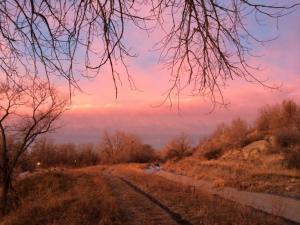
Laid down during the Late Cretaceous, 100 to 66 million years ago in the heyday of the dinosaurs, the massive cliffs appear to be the remains of a long barrier island that stood between a coastal lagoon and the shallow inland sea that flooded most of North America during that time.

Today, dawn is flung from that barrier island into my home and heart.

I know that the Earth community stands on the brink of another ending, the end of the Cenozoic, heyday of flowers, birds, mammals and, recently, humans. I am pondering a sacred scripture, wisdom laid down a mere two thousand years ago: Jesus’ parable of the fig tree (Luke 13:6-9). Can this wisdom stand as a barrier to the destruction increasingly caused by industrialized, militarized, human societies on a rampage of fossil-fuel burning? Better yet, can it inspire a new human-Earth harmony?

I think so.

Four Gospel insights for addressing climate change

The economically savvy vineyard owner instructs his hired vinedresser to cut down the unproductive fig tree. It’s taking up valuable garden space and gulping scarce water. “Wait,” says the vinedresser who respects the fig tree. …

Step one in God’s Action Plan for a flourishing Earth Community: Stand up and stop the destruction.

85369_990x742-cb1414687886This is not easy. It requires steady, long-haul, nonviolent resistance to violence against Earth. It means solidarity with people who live near toxic waste dumps or vast oil and gas fracking sites, with families living downstream from the chemical run-off of factory farms or the horror of oil “spills.” It demands speaking an inconvenient truth about our ruinous addiction to fossil fuels.

And it demands providing positive, Earth healing alternatives. Jesus, the parable teller, does just that. He’s observed farmers carefully.

“Let me dig around the fig tree, water it, apply some manure,” suggests the vinedresser.

Step two: Learn how Earth works and follow that.

7

Apply Earth’s methods to how we do transportation, home heating and cooling, agriculture and health care.

Design vehicles that glide through air like fish through water, running on solar powered cells. Create buildings that generate more energy than they use, and that recycle the wastes they generate. Plant seasonal gardens. This is known as biomimicry.

“Now, let’s give the fig tree some time. Wait a year,” says the vinedresser. Ah ha! Don’t be in a rush.

Step three: Embrace the pace at which Earth does things.

I reach into my prayer basket for a version of the 23rd Psalm from Japan. There are few, if any, herds of sheep in Japan. In Wyoming a cowboy preacher called the Lord “my buckaroo.”

“Lord, You are my pacesetter, I shall not rush. You make me stop for quiet intervals, providing me with images of stillness which restore my serenity. You lead me in the way of efficiency through calmness of mind. You guide me in peace. Your timelessness keeps me in balance. You anoint me with oils of tranquility.” Gracious instructions for how to give the fig tree of Earth, and our soulful creativity, time to heal and regenerate.

In due time, enjoy the nourishing figs.

fig-fruitJesus’ listeners, familiar with the kings and prophets of Israel, see a crowd of images around a fig tree as they hear the parable. In 1 Kings, the peace and security of Judah and Israel is described as each family enjoying their vine and fig tree (4:25). In Zechariah, the people are told to invite each other to “come under your vine and your fig tree” (3:10). Inherent to this idyllic imagery is a scrupulous economic system of just distribution of land, goods and labor, as well as adequate food for all, shared. The story of Jesus feeding the crowd of thousands is evoked. Equitable economic systems are the rock solid foundation for a flourishing Earth and peace among all peoples.

Step four in God’s Action Plan: create equitable economic systems.

Unknown-2

The Fig Tree. This humble image of God’s stalwart shalom for the whole Earth community energizes us. It sweetens our aching efforts for just distribution of Earth’s goodness. It strengthens us as we work to transform massive, entrenched unjust systems into local, resilient communities that flourish by guaranteeing our rights to housing, food, water, education and meaningful work. And, developing economic systems from that. We feel at home as vinedressers.

And who is Jesus’ vinedresser? “My Father,” he says. (Jn 15:9)

I step through my front door into sunset. The cliffs are aglow. I hear a scream and look up in time to catch glimpse of a pair of red-tailed hawks in a glide beneath them. No need for candles. Light everywhere.

80259757.dKxD7CZ6.070304RedtailedHawk4696b

*An Oldenburg Franciscan Sister since 1963, Marya Grathwohl lived for more than 30 years in African American, Crow and Northern Cheyenne communities, as teacher, principal and pastoral minister. She is the founding director of Earth Hope, and works in environmental restoration through farming, restoration and other ecology projects.

EXTINCTIONS

That we are heading into, or are already well inside, Earth’s Sixth Great Extinction is probably not news to readers of this blog. It’s sadly certain. I had considered focusing a Lent reflection on extinction of species sometime in the future. In the three-year liturgical timetable that my reflections follow, Lent 2015 would be Air’s turn. I figured I could update Lent 2012 for use in 2015 and think about species for another time.

100_0751However, people in various groups that had used Air in 2012 asked what else I would offer. I decided to let the Scripture reading make the decision. Turns out that next Lent’s First Sunday readings include God’s covenant with all creation. That settled it, and I started writing.

Lent 2015

As usual, I began with our place in the Universe Story, the sacredness of all life, our interconnectedness and interdependence. I continued with information about species: numbers suffering extinctions and threats, causes and solutions. I included prayers of grieving and actions to continue efforts to improve present reality. I recommended videos of fish, birds, and mammals, plus heroes who worked to save them.

I finished Creation Covenant: Reflections on Fish, Birds, and Mammals for Lent 2015. My various proofers did their thing —bless them and their giftedness! — but I had a nagging feeling that I’d missed something.

Well, I found it, and I think it’s worth a blog.

Endangered Species Act

My Aha! came when I read key parts of the 1993 Endangered Species Act (ESA). imagesYou might be surprised to know that the act’s first purpose is not to save species! That goal follows from the first:

“The purposes of this Act are to provide a means whereby the ecosystems upon which endangered species and threatened species depend may be conserved, [italics mine], to provide a program for the conservation of such endangered species and threatened species, and to take such steps as may be appropriate to achieve the purposes of the treaties and conventions set forth in subsection (a) of this section.”

Ecosystems

The ESA’s authors realized that the primary way to preserve species is to conserve their habitats: the complex of climate, food resources and multiple species that evolved interdependently over millions of years in each of the various bioregions of Earth.

Planet Earth is itself one inclusive ecosystem of which the human species is a part. Our species is totally dependent upon the rest. If we destroy our habitat, where can we go to survive?

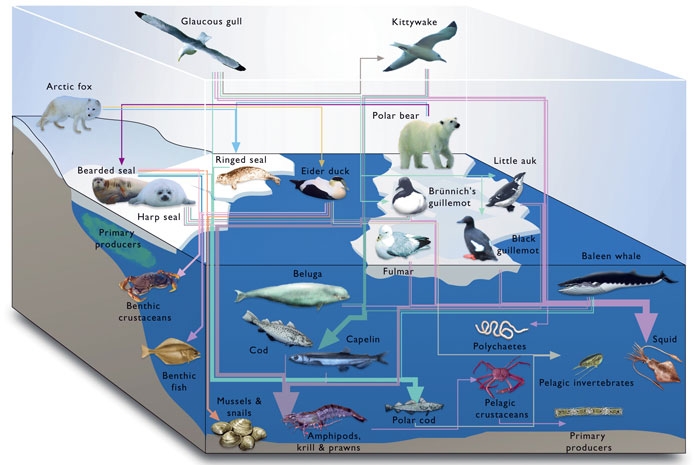
marine_ecosystemsWe’ve all heard about the butterfly wings flapping in one place that cause weather changes someplace else. Ecosystems affect one another. That level of interactivity cannot easily be visualized. Nor can we see essential components of local ecosystems in a photo or watch the slow evolution happening even as an image is taken.

We cannot see a species’ preferred climate, its predators or what it consumes to keep the ecosystem in balance. We cannot see soil quality or water salinity, all the other living organisms, and the chemical and other factors that have developed together to provide a home in which the various species can thrive. It’s the whole that needs primary care. God’s covenant was not with species, but with creation.

Habitat Loss

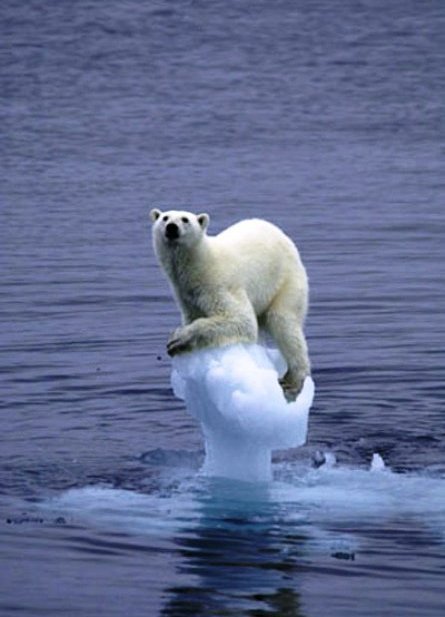
Yet I, and many others, have been focusing on species. Images of a given endangered species — like the polar bear here — get-attachmentimmediately reach open hearts. We can relate to a given fish, bird, animal, plant. It’s way harder to image an ecosystem. Might seem like the chicken and egg question, but the ESA — and logic, after some reflection — is clear: start with the ecosystem. That change in attitude is now required. 

Scientists agree that habitat loss is the greatest cause of extinctions. The Endangered Species Act confirms that conserving specific habitats is the primary issue needed to save species. Save the ecosystem, and we save everything living within it and dependent upon it. As Thomas Berry often repeated, “Nothing is itself without everything else.” (True for humans, too.)

Attitude (and Punctuation) Shift

This highlights an evolution needed in our brains. We’ve evolved in recent centuries to think of ourselves and items in the rest of nature as individuals. This awareness was important, a beginning, but now it’s time to become more aware of how these individuals inter-exist. (C.f., https://ecospiritualityresources.com/2013/10/20/stages-of-cosmic-consciousness/.) The pyramid structure — God on top, then men, then women, etc. down the line — didn’t include a spot for ecosystems, and we are now challenged not just to include ecosystems, but to place everything– including ourselves — within that context. That’s reality! We rarely perceive the interaction in an ecosystem, but that’s a skill every human needs to develop.

So I shall revise Lent 2015. One example: I had written “The reasons for species extinctions include these: habitat loss, global warming, pollution, deforestation, land development, habitat fragmentation . . . .”

I’ll make this change: “The primary reason for species extinction is alteration of ecosystems. [full stop] This happens through climate change, pollution, deforestation, land development, habitat fragmentation . . . . .”

Local Ecosystems

Brian Swimme, in The Hidden Heart of the Cosmos (1996) invites readers to take the “local universe test”: imagine inviting someone “to visit you who lives at least twenty miles away and who has never visited you before . . . . In your directions you images-1may refer to anything but human artifice . . . hills, trees, constellations of the night sky, the lakes or ocean shores or caves, . . . any ponds, trails or prairies, the Sun and Moon . . . .” and so on. But nothing human-made.

What trees, flowers, and birds are native to your area, having evolved over centuries? Where does the water come from and go to? Is anything endangered for any reason? What do you know about the millions-of-years evolution of your area? How does it change with the seasons? Have you had, or can you imagine others having had, awe-inspiring experiences here?

Perhaps if we were more conscious that we are co-creating our ecosystems, we would be more eager “to provide a means whereby the ecosystems upon which endangered species and threatened species depend may be conserved.” This awareness might also help us realize how the health of individual bioregions is essential to the health of the entire planet, our precious home. May we recognize its sacredness and respond to its needs.


“. . . a constantly changing world.” SHCJ Constitutions

Every major religious and philosophical system began before anyone knew what we know about our place in space and time. In all human history, no one knew what you know about “the heavens and the earth”!

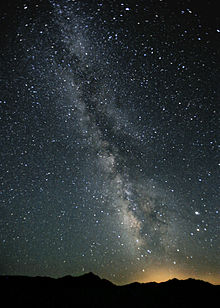
OUR PLACE IN SPACE —                                           Milky_Way_Night_Sky_Black_Rock_Desert_Nevada

Do you remember how you felt as you looked at the stars when you were little?
• Did you guess that some “stars” were entire galaxies containing billions of stars?
• Did you guess that some stars had burned out, but their light was still traveling to your sight — in some case traveling billions of light years?
• Did you guess that the total number of stars exceeds the grains of sand on Earth?”
• Did you guess that everything you saw was expanding and creating space as it expanded?
• Did you guess that our Earth and everything that is part of it (including you)  came from the dust of a star that had burned out billions of years ago?

We now know this and more!

We are the local embodiment of a cosmos grown to self-awareness . . .
star-stuff pondering the stars!     Carl Sagan
.

The Holy Spirit is that divinely imbued empowering energy operative in creation from time immemorial.    Diarmuid O’Murchu

.

In the beginning was the Word – the Logos, the inner order of things.   John1:1

How does this reality affect you – your sense of the divine, of yourself, of others and all creation?