Please see the 2018 prayer at https://ecospiritualityresources.com/2018/12/05/winter-solstice-prayer-2018/
Archives
REFUGEES, CLIMATE CHANGE, YEAR OF MERCY
Refugees
I am writing this on Thanksgiving Day in the United States, a day we join with friends and family to give gratitude for the abundant blessings we enjoy. In contrast, think of what one refugee replied when asked what he had brought with him on the boat heading for Turkey. He thought for a moment and answered: “Sadness.”
This man is caught in the greatest migration since World War II. Though numbers cannot  be exact, the UN High Commissioner for Refugees reports that 2014 saw almost 60 million women, children, and men displaced either within or outside their home areas. That number is approximately the population of Italy!
How we respond to the hundreds of thousands of refugees fleeing terror and persecution, war, poverty, gangs, climate change, and hopelessness is a major issue for both leaders and citizens of the countries to which these homeless people flee. We must get beyond the numbing numbers and “feel” the plight of individuals. For those aware of how closely we are interconnected to all creation on our common home, the decision to welcome these brothers and sisters is inescapable.* (The US terror attacks have come from within.)
Connection to Climate Change
Researchers and policymakers warn that these numbers are sure to increase because of climate change. The Internal Displacement Monitoring Center states that roughly three times as many people were displaced by environmental disasters between 2008 and 2013 than fled from conflict and violence.
U.S. Secretary of State John Kerry warned recently that the scenes of chaos and heartbreak in Europe will be repeated globally unless the world acts to mitigate climate change. “Wait until you see what happens when there’s an absence of water, an absence of food, or one tribe fighting against another for mere survival,” Kerry said.
Climate change leads to crop failures, natural disasters, higher food prices and the spread of waterborne diseases, creating poverty and pushing people at risk into destitution. The World Bank warns that rising temperatures could drive 100 million people into extreme poverty. Professor Norman Myers of Oxford University and other reputable scientists put the number at twice that amount.
Talks in Paris now until Dec. 10 give hope that the world’s leaders will take positive steps to reduce climate change and thus reduce refugee numbers in the future.
Jubilee Year of Mercy
 Care of Earth and care of humanity cannot be separated. Pope Francis recently said, “There is a clear link between the protection of nature and the building of a just and equitable social order. There can be no renewal of our relationship with nature, without a renewal of humanity itself.”
December 8th begins the Roman Catholic Year of Mercy that extends to November 20, 2016. Calling us to a spiritual conversion, Pope Francis writes: “We want to live this Year in the light of the Lord’s words: ‘Be merciful, just as your Father is merciful.’ (cf. Lk 6:36)” Addressing Catholics, he writes: “I am convinced that the whole Church will find in this Jubilee the joy needed to rediscover and make fruitful the mercy of God, with which all of us are called to give consolation to every man and woman of our time.”
It seems relevant that Human Rights Day will be celebrated two days after this special year begins. The Year of Mercy reminds Catholics — and others — to show mercy by helping refugees achieve their human rights. Welcoming refugees is a direct response to the Gospel mandate to welcome the homeless and treat everyone as we would treat Christ. It is an important way to show mercy. We also practice mercy by taking action to mitigate the reasons — like climate change and war — that cause people to flee their homes.
Listening to those who would withhold compassion for certain groups makes one wonder if the innkeepers who refused Joseph and his pregnant wife 2000 years ago truly had no room, or if they didn’t choose to accept people from Galilee. How sad if we could be similarly blinded!
* Entering the United States as a refugee is already a long and difficult process. It takes anywhere from 18 to 24 months or longer, and involves the FBI, Homeland Security, the National Counterterrorism Center, the Defense Department and the State Department. Your biometric data is checked against law-enforcement databases. You must pass a battery of interviews. And if you’re from Syria, the process is even more rigorous.
*My parish, St. Gertrude, Chicago, true to its pledge that “All Are Welcome!” is making plans to welcome a family from Syria (or whatever family is in need). Over 100 parishioners have volunteered to help, and the entire parish will contribute as needed.
LAUDATO SI’s EDUCATIONAL CHALLENGE
 In Laudato Si’, Pope Francis presents “an educational challenge” (par. 209) that requires “educators capable of developing an ethics of ecology, and helping people, through effective pedagogy, to grow in solidarity, responsibility and compassionate care.” (par. 210)
The goal of this education is described throughout the Encyclical. For example:
– “awareness of our common origin, of our mutual belonging, and of a future to be shared with everyone.” This basic awareness, he predicts, “would enable the development of new convictions, attitudes and forms of life.” (par. 202)
– “It cannot be emphasized enough how everything is interconnected. Time and space are not independent of one another, and not even atoms or subatomic particles can be considered in isolation.” (par. 138)
What follows is a model of such a program. I am indebted to  Dr. Orla OReilly Hazra, PhD, and to her students, for the following information and quotes.
Offering an Integrated Cosmic Vision
Orla and Prashant Olalekar, PhD, S.J. co-taught an honors course titled “Be the Dream: Awaken to Cosmic Compassion” at St. Xavier’s College, Mumbai. (For information about the course, see
IGNATIAN PEDAGOGY in an Evolutionary Universe: Report on Honours Course, St. Xavier’s College, Mumbai, India)
Their students included the age group of 18-22, a variety of academic majors, and an even wider range of faith traditions, plus two teachers. These students learned the story of our 13.8 billion-year-old Universe. They absorbed the reality that our bodies and the bodies of all we see around us are part of everything that emerged from this evolution. The Universe Story — unknown for so long — conveys the wonder and awe that overwhelms many scientists as they face the stupendous creative power animating our journey together.
 The big history of our lives was outlined through its 8 threshold moments: big bang, formation of galaxies, elements, solar system, life, humans, agricultural era, industrial era (and end of Cenozoic era from which we emerged) — and now our emerging 9th moment – the ‘ecozoic era’.
With this solid foundation, these students proved that “if we feel intimately united with all that exists, then sobriety and care will well up spontaneously.” (par. 11)
Results
The following quotes show that these students, confirmed in their place in the Universe Story, accept their responsibility for co-creating and fostering the flourishing for all. Their common response after listening to and meditating on their integral origin story was one of deep awe, wonder and reverence. Their journal entries reveal that they are now able to see their bodies and themselves and all around them as part of an integral co-creative process:
“We are such an amazing and significant part of this universe, evolving together with all species and forces of nature. I am mother earth and mother earth is me. Knowing about this cosmos has been the first step towards unraveling the purpose of my life. Having understood this, I wonder, won’t it solve our issues of inequality for we are cutting down separation/discrimination from its basic root” (Shweta)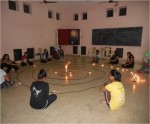
“The Big Bang theory has never affected me the way it did today. We are all interrelated, we have emerged from the same stars. Thus my view has changed dramatically when it comes to looking at the problems of the world. The meditation did help us to delve deeper. I did notice that I should listen to myself and nature even more.” (Renisha)
“The immediate change on the surface level is to become sustainable: reduce use of plastics, eliminate shopping cravings, make homemade food and beauty products, a deep acknowledgement and compassion for my skin, my organs, my body that has been supporting me … maybe ever since 13.8 billion years … at moments like these I realize that I cannot continue my speech of ‘them’ and ‘us’ because we really are one, and we need to fight not only for the marginalized but also for Mother Earth. If I sit cross legged [in Indian meditation prayer] and decide that there is nothing I can do for Mother Earth, whose metals, atoms, chemicals are that which sustain and have made me, isn’t it rather a bit selfish and foolish to be doing?” (Kala)
Ecological Conversion
Awareness of the integral existence of the Mystery in all things is the metanoia necessary. We currently struggle with a mindset that denies, rejects, or is simply unaware of our unity with all creation. As stated by Bernard Lonergan, SJ: “How indeed, is a mind to become conscious of its own bias when that bias springs from a communal flight from understanding and is supported by the whole texture of a civilization? (Lonergan, 1958, xv)
Healing the dualist mindset bias which is causing the problems in the first place is essential for the education advocated by Pope Francis. As ecotheologian Diarmuid O’Murchu rightly points out: “Reconnecting with the Earth – with the whole Earth — is the single greatest challenge now facing us as a human species.” Our primary context of the Cosmos is the basis of any ‘religious’ story and is the commons from which we all emerged.
The course described here, and experiences like it in schools, families, parishes, religious congregations, and organizations of all types, prove that from understanding our common heritage and common ground, a common reverence and responsible action can emerge globally — and with joy!
Call for More Examples
Please add, in comments, other examples of ways parents, teachers, authors and artists are enabling others to place our lives and our religious stories within the unity of all creation.

 ecospirituality resources