Stages of Cosmic Consciousness

A cosmology is not just a theoretical enterprise, but a way also to gain our bearings in the inner world.  
Mary Conrow Coelho

More and more people are deepening their awareness of Teilhard de Chardin‘s insight:lead_teilharddechardin

In Teilhard’s estimation . . . it is in us, and as far as we yet know, only in us, that the Creation has become self-aware. Our eyes are the eyes through which the Earth finally beholds her own beauty, and, just as importantly, knows that she beholds it. Human beings are not above the Creation, but are themselves the Creation, that part of the Creation that is self- conscious.  John R. Mabry

I found that a hard saying when I first heard it (from Miriam MacGillis in 1979). It took me years to identify myself that way, steeped as I was in a cultural paradigm of separate, isolated components with humans in a compartment by themselves. I still pray to deepen my awareness of being integral with the rest of creation, helped now by many authors, speakers, and the “field” of awareness in which I live — to which readers of this website undoubtedly already contribute.

JOURNEY TO WHOLENESS

timthumb.phpVarious theories of levels or stages exist. Mary Inglis, presently based at Findhorn, Scotland, wrote an article about this decades ago that I still find helpful: “Journey to Wholeness: The Message in Myths.” Originally published in OneEarth magazine, it follows the interplay between the masculine and feminine principles/energies. I find Inglis’ three basic stages of this evolution applicable for other topics as well.

See if you find these very simplified highlights (which Mary has approved) of her article applicable to the interplay between human consciousness and our relationship to the rest of creation — historically and/or personally:

1. Unconscious, undifferentiated, pre-conscious oneness; it precedes polarity in human thought; human life patterns correspond with those of the natural world

2. Awareness of separate identities; exploration and deeper understanding of different components of creation; scientific belief that everything is atomic; dualities, dominance, competition

3. Conscious return to unity and interdependence, fully honoring variety and complexity and their interconnectedness.

Inglis does not name Thomas Berry‘s three cosmic principles (communion, autopoiesis, differentiation) or quote him (e.g. Nothing is itself without everything else.), but her third stage affirms them.images

Try reading Mary Inglis‘ ending with ecospirituality in mind:

[The third step] involves a willingness for grace to be active in our lives, for there is an element in it in which we do not choose it: it chooses us, if we are ready and open. . . . It asks that our actions and autonomy may reflect and be in the service of  a larger wholeness. . . And it is not a step that is taken once and for all, but is required to be made again and again, for it arises out of the continual pull to both self-sufficiency and self-transcendence.

Ultimately the individual conscious self only has meaning as it becomes a revelation and expression of the larger whole. It is through the capacity to surrender that the connection between the two is made, allowing the life of the spirit to guide and inform our actions, and bringing us to the knowledge and experience of our essential unity and interdependence with all creation and to the expression of this in our lives. As this happens, we return to the place from where we started, and know it for the first time.

AFFIRMATION OF INGLIS’ STAGES

I think of this article when I read quotes like the following:

Evolution goes beyond what went before, but because it must embrace what went before, then its very nature is to transcend and include, and thus it has an inherent directionality, a secret impulse, toward increasing depth, intrinsic value, increasing consciousness. 

Ken Wilbur

images-1We have the capacity to make choices that will evolve us, both personally and as a species. We have the capacity to engage in the management of the whale-sized issues that confront us, most of our own making. We have the capacity to cooperate with the unfolding of the universe, a process driven by grace, which invites us to be co-creators. . . . What if we were to engage our energies as consciously as possible in order to influence and help manifest this new emerging consciousness, a consciousness rooted in the past, yet filled with promise for our species and all life on our planet?  Judy Cannato

John Seed, the rainforest activist, tells of his sudden Aha! moment when acting to preserve a rainforest in Australia: I am part of the rainforest protecting myself. I am that part of the rainforest recently emerged into thinking.

There are no independent entities. Human individuality is not to be confused with human independence. We depend on the functioning whole and derive our being from it.  Mary Conrow Coelho

CONSCIOUSNESS OF THE DIVINE

Believers might find these stages applicable also to humanity’s consciousness of the divine. Perhaps they would be helpful to people who feel they have “lost their faith” — when they’ve just moved out of Stage Two and have not yet settled into Stage Three.

During humanity’s journey, cultures and religions immersed themselves in, named, and often fought over, their god(s). Mystics in various religious groups took the lead in “leaving god to find God” as they reached Stage Three. Modern science often helps people reach it, as do theologians and mystics like Teilhard de Chardin – but it’s often hard!
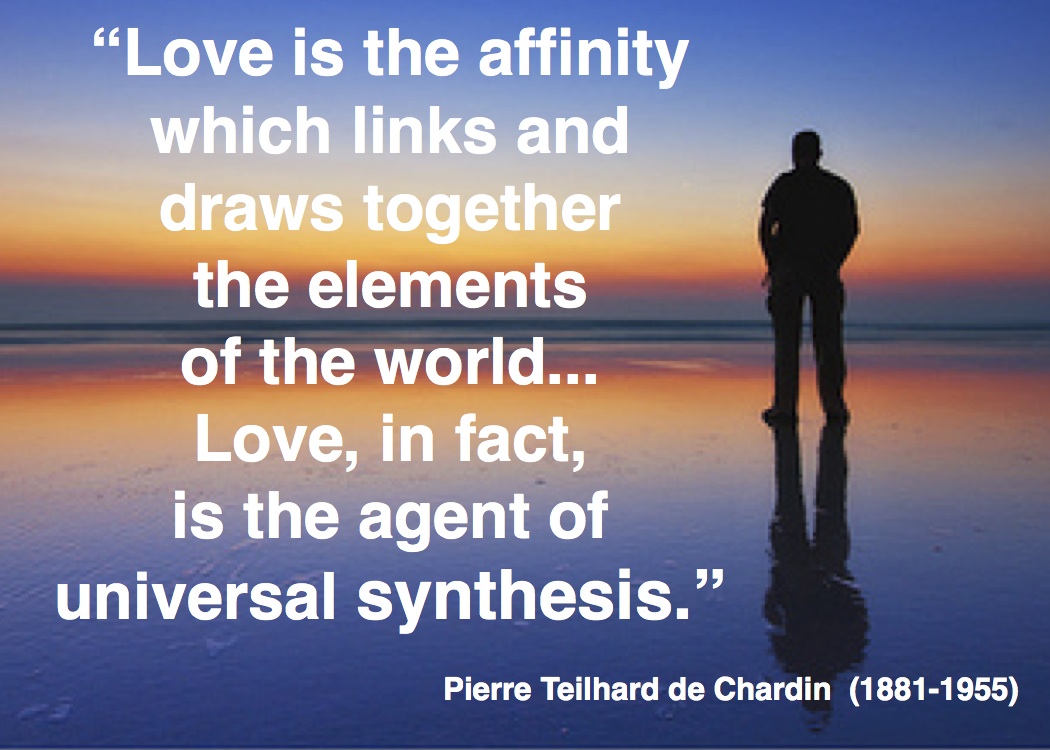
2-teilhardThe journey requires careful discernment of what to bring forward, what needs reinterpreting in light of new knowledge, re-creating systems that no longer function effectively within a new wholeness. Thomas Berry warns/challenges that it requires “reinventing the human.” Teilhard de Chardin reminds us that “We are collaborators of creation” and the energies of Love make all the difference.

We are, indeed, united with the cosmos and with the divine — understanding them distinctly, yet transcending isolation as we become aware of our interconnected whole and our role in co-creating it.

Inglis’ three stages of evolution help me “transpose” all religious writing that took place in Stage Two and make sense of it in our own evolving worldview.

Even Jesus‘ prayer in John 17 — That all may be one as you Father are in me and I in you. I pray that they may be one in us. . .  — can be understood in this light. The unity already exists; our task is to live into consciousness of it.

images


Francis, Creation, Climate

The feast of St. Francis (October 4th) is a good time
to remember several things:

1. Francis of Assisi’s love of creation and
ability to find God everywhere,100_0359
2.  Pope Francis’ call to everyone to care
for creation,
3.  the urgency of reducing climate change, and
4.  for SHCJ and those who love Cornelia Connelly, to remember how devoted Cornelia Connelly was to Francis.
 
1. Francis of Assisi is known for his practice of poverty and concern for the poor, his efforts for peace, and his love of all creation. His Canticle of Brother Sun praises all God’s creatures, calling them Brother and Sister – and “our Sister Mother Earth.” Pope Francis’ choice of this saint’s name was very deliberate.

2. Pope Francis, speaking of the journey towards ending mental and spiritual poverty, recently said:
But it is a difficult journey, if we do not learn to grow in love for this world of ours. Here too, it helps me to think of the name of Francis, who teaches us profound respect for the whole of creation and the protection of our environment, which all too often, instead of using for the good, we exploit greedily, to one another’s detriment.

3. In celebration of the Feast of St. Francis, the Catholic Coalition on Climate Change is sponsoring 
national climate change education events in Catholic parishes, schools, and colleges. They list these goals for education efforts for this feast day:
  • Understand more fully the reality of climate change;

  • Be inspired by Catholic Church teaching about climate change and the call to respond;

  • Deepen awareness that this call is to BOTH care of God’s gift of Creation AND care of those most impacted by environmental neglect, including climate change — namely, creation’s poorest and most vulnerable;

  • Engage both personally and as a community in concrete ways that respond to the Catholic call to care for Creation and protectors of the vulnerable, by taking the St. Francis Pledge to Care for Creation and the Poor: http://catholicclimatecovenant.org/the-st-francis-pledge/;

  • Build leadership for future efforts to integrate Catholic values of environmental care and outreach to the poor.
 
arcticmeltThe group  recommends two resources to better understand climate change and the necessity of changing it:
– the Pontifical Academy of Sciences ’s Working Group (PAS) statement, Fate of Mountain Glaciers in the Anthropocene, and

– a “TED” talk by James Balog, the science photographer behind the documentary film Chasing Ice, who documented some of the most vivid evidence yet of climate change. 
 
I am happy to note that I included highlights from the PAS statement in the video “Time for an Energy Change” (https://ecospiritualityresources.com/media) as well as in the Lent programs for Air 2012, Water 2014, and Air 2015  (https://ecospiritualityresources.com/lent).
 
In their declaration, PAS calls on all people and nations to recognize the serious and potentially irreversible impacts of global warming caused by the anthropogenic emissions of greenhouse gases and other pollutants, and by changes in forests, wetlands, grasslands, and other land usesDuring the 2012 Lent Air session at St. Gertrude, Chicago, participants were overwhelmingly surprised and elated that the Church was highlighting this issue. They discussed the content with obvious commitment.
 
4. As for Cornelia Connelly, her call to meet the needs of the times alerts us to combine both the climate change issue and care for those impoverished by it. The following quotes, taken from an article by Aquilla Peterson, SHCJ, in 2003, indicate Cornelia’s devotion to Francis and his influence on the SHCJ spirit:


“To Saint Francis of Assisi she had, from the first, been strongly drawn. Of him she writes: ‘He shows in his contempt for the things of this world the highest elevation of mind; in his profound abasement a heroic courage, in his extreme simplicity, the most noble sentiment; in his weakness and apparent folly, the strength and wisdom of God.’  She repeats with him: ‘There is nothing on this earth that I am not ready to abandon willingly and with my whole heart, nothing however painful that I am not willing to endure with joy, nothing that I am not willing to undertake with all the strength of body and soul for the glory of my Lord Jesus Christ…”   Catherine Gompertz, Life of Cornelia Connelly; 1st  edition, p.85 (London,1922)  


“In her love for St.Francis, Cornelia for a long time entertained the idea of having the Society affiliated to the Franciscan Order. She even distributed the cord of St.Francis to the Nuns in most of the convents in 1876 and was able to obtain for the Society, the privilege of the Porziuncula Indulgence [Franciscan tradition of indulgence of pardon] for seven years.”   Ibid. p. 195


At Derby in 1848, Cornelia used the Fioretti (Little Flowers) of St. Francis for community reading. The Sisters took turns reading stories from it and it was through these “Little Flowers” that the Franciscan spirit was imbued in the Society. “Cornelia, like Francis, was drawn to the stable of Bethlehem where God was strong in weakness and where having nothing, he possessed all hearts.”   Informatio, p.197 
 
“The spirit of poverty she placed under the patronage of St. Francis. This practice could not, for obvious reasons, be carried out quite on the Franciscan lines but she wished her Nuns to vie with the followers of the Saint in poverty of spirit, and to bear cheerfully any privations that fell to their lot.”   Gompertz p. 195


[O]n Sept.17, 1841 while on retreat, Cornelia took the third degree of humility and wrote “vocation examined and decided.” So it was, that her vocation was decided on the retreat commencing on the Feast of the Stigmata of St. Francis of Assisi. “We can only imagine Francis looking down on his friend of the Holy Child Jesus for her heart was indeed stigmatized.”   Document #64-70, 52 
 
According to Buckle and Bellasis the influence of St. Francis of Assisi on Cornelia and the SHCJ was significant, e.g., ‘We now have a good idea of the Franciscan and Jesuit element in Mother Connelly’s soul — that the devotion to the Holy Child and the poverty of the crib was inspired or borrowed from St. Francis and the interior life from the teaching of St. Ignatius.’   Caritas McCarthy, SHCJ, Spirituality of Cornelia  Connelly, p.167 (New York,1986)
 
In 1854 while in Rome, Cornelia began painting a triptych with St.Ignatius on one side, the Holy Child in the center, and St.Francis on the other side. What was finished of it now resides in Mayfield. This would indicate that she had come to regard these two very different founders as copatrons of the spirit and rule of the Society.   Aquilla Peterson’s article “St. Francis of Assisi and Cornelia Connelly” 2003, p. 2
 
Finally, at her death in a sparsely furnished cell, was found a crucifix, a picture of the Sacred Heart, a picture of the Blessed Mother with the Holy Child and an engraving of St. Francis of Assisi leading a lamb.   Ibid. p. 3
 
 
I can easily imagine that Cornelia would rejoice in all efforts — by anyone — to reduce carbon emissions and thus reduce climate change, one of the major needs of our times that harms and threatens so many. She also would have made the connections of resource scarcity, environmental refugees, and wars. 
 

For Reflection:

~ If he were alive today, how might St. Frances advocate celebrating October 4th?

~ How can you connect the issues above with celebrating Francis’ feast day?


Human Trafficking

Human Trafficking: Preventable Modern Slavery

 Everything is interconnected. Thomas Berry liked to remind people that images-1 creation is    a communion of subjects, not a collection of objects. Thus care of our beloved Earth includes care for every component of it. This season the Sisters of the Holy Child (I am one) are focusing our corporate justice efforts on human trafficking.

A 2012 report from the United Nations Office on Drugs and Crime on human trafficking says around 20.9 million victims are forced into labor globally. “Labor” includes any work that is not voluntary, where freedom is denied and, too often, conditions are deplorable. This includes situations that are agricultural, domestic, manufacturing, or sexual. Trafficking for organ transplants also occurs.

Human trafficking is not limited to poor and underdeveloped areas, but extends to all world regions, including cities throughout the United States. Given the rapid increase in this slavery, it is possible that trafficking in persons could exceed the trafficking of drugs and arms, making it the most lucrative criminal activity in the world.

32e65800-286e-11e2-bf96-005056b06a0e-5436920 - Version 2


Many countries 
(and states in the U.S.) have made laws meant to stop trafficking and assist victims of it. Vatican experts will gather November 2013 to tackle the growing scourge of human trafficking. The bishop’s academy, with the Pontifical Academy of Social Sciences and the World Federation of Catholic Medical Associations, will meet at the Vatican City’s Casina Pio IV to discuss a Vatican action plan to help combat what is often referred to as the modern slave trade.

                 images-3     

Buying Fair Trade coffee and chocolate is one sure way to                                     reduce the demand for trafficked laborers.

Children are often trafficked to be used/abused in the growth and production of both coffee and chocolate. Multiple reports show that children aged 12-16, but sometimes as young as 7-9, are tricked, smuggled, and sold to work as slave labor working with coffee beans and cocoa beans. Thus one way to both care for creation and reduce trafficking is to purchase sustainable and fair trade coffee and chocolate.                                                                                       

images-1

Fair-trade certification means that workers are paid fair wages, are free from abusive, exploitative labor practices, work in healthy and safe conditions, and that land, water, and birds are protected because growers use environmentally sustainable methods. Hundreds of thousands of farmers and workers in about 70 countries have benefited from fair trade practices.

By buying fair-trade coffee and chocolate we increase the demand for products free of abusive child labor and slavery.

When buying coffee and chocolate (and other products), check for a sign that it is Fair Trade. Some products have a rectangular black and white seal; others (e.g., Equal Exchange) mark themselves as “Fairly Traded” or (e.g., Theo chocolate) “fair for life.” Recommended coffee companies include Equal Exchange and Thanksgiving Coffee Company. Look for fair trade labels on other brands (e.g., Dunkin’ Donuts, Starbucks, Allegro, Green Mountain, Ben & Jerry’s) that provide some, but not all, fair trade.

These brands might be more expensive than brands like Nestle (Hills Brothers, Nescafe, Taster’s Choice) and Philip Morris (Brim, General Foods, Gevalia, Maxim, Maxwell House, Sanka), but the cheaper price might mean that child labor — or poor sustainability practices — are used. (No, I am not accusing these brands.) In this case, we definitely don’t want to buy the cheapest product! Reducing child trafficking is surely priceless!

Those who already buy only Fair Trade products can be comforted to know that they are reducing the number of children who are trafficked. Naturally buying fair trade products will not eliminate all human trafficking, but it will take a bite (sorry, couldn’t resist) from this modern slavery.