My last blog shared insights about saving species: that a key factor is to think ecosystems rather than merely focus  on isolated species — even though they are easier to image and more likely to motivate us to action. We need to develop the consistent ability to “see” interconnections and protect entire habitats.
Thomas Berry always said that nothing is itself without everything else. This might be especially pertinent when thinking about the species closest to our hearts: the one containing human hearts. Thomas also said that reinventing the human was part of the Great Work of our time. Pope Francis’ recent statements seem to agree.
Eco Catholic blog
 Sharon Abercrombie’s 6/24/14 blog on the National Catholic Reporter (NCR) site (http://ncronline.org/node/80236) caught my attention. Small wonder. Here’s how she begins:
True or false? Our current ecological crisis is a completely new development in the history of humankind — a situation only 200 years old, a nasty byproduct of progress fostered by the Industrial Revolution.
If you voted “true,” that’s just a bit false. It’s not the whole story.
To get the full picture, take a gigantic leap back into time beginning with the Old Stone Age. Those ancestors content to kill just two mammoths instead of one were still behaving sustainably. But the ones who took the shortcut approach by driving entire herds over a cliff, were eventually defeated by their own “progress,” running out of a major food source for their lunches.
Sharon continues with insights from “Surviving Progress [1]”: a 2011 film directed by Mathieu Roy and Harold Crooks, and with Martin Scorcese among its executive producers. “Surviving Progress” tells us where we’ve been and where we are going ecologically as a species. It warns that the outcome for us and the rest of the planet will be disastrous unless we melt down the edges of our Ice Age mentalities with an expanded, inclusive moral consciousness. I highly recommend this powerful documentary for summer spiritual televiewing (A complete transcript [2] is also available on the film’s website).
I like to imagine the interconnections of the various individuals within these civilizations rather than thinking solely about the humans (in a lump sum) and their accomplishments. The facts and theories are the same, but new light is shed when we remember how interconnected each human was with everything and everyone else within its biosystem: from microorganisms to other humans, from soil to water to air, from climate to lifestyles . . . .
Extinct Civilizations
Recent reports about climate change impel responsible humans to consider prayerfully the implications of global ecosystem collapse and the fact that it could imperil all species as well as the future evolution of planet Earth.
At least ten, probably more, thriving civilizations have disappeared from various locations on Earth, many prior to the Christian Era (BCE). One wonders what individuals in these civilizations thought as their ecosystem became threatened. Denial? Trust in the gods? Futile blame-games? Resignation?
Top theories for extinctions of civilizations include invasion and ecological causes like volcanic eruptions, climate changes leading to drought, and over farming or over hunting causing starvation. Extinction won. This need not happen again if we learn from the past.
“Surviving Progress”
NCR has graciously allowed me to reprint Sharon’s blog, and the rest is hers:
“Surviving Progress” features authors, environmentalists, historians and economists and includes such notables as David Suzuki, Ronald Wright, Margaret Atwood, Jane Goodall and Stephen Hawking. Activists from the Congo, Canada and the United State complete the cast.
Viewers will come away with their own particular memories, but one of mine was the realization that ancient Rome became an early prototype for our current economic system — the wealthy minority at the top of the pyramid versus the rest.
In those days, it was the custom for Sumer, Babylonia, Egypt and other countries to occasionally cancel their debts when they became too unwieldy. This policy created a clean slate so that societies could start afresh.
 Rome, however, did not approve of such mercies, instead waging war with kings unable to pay their debts, explained economist Michael Hudson. Like plagues of locusts, Roman legions stole gold from the temples and public buildings, stripped cities of their waterworks, and created a desert from the land.
“A debt is a debt,” became the Roman calling card. Egalitarian lands, where peasants formerly had access to public land, were taken over by the lords and generals. This move helped to create widespread homelessness, the creation of slums and ecological problems.
Canadian author Ronald Wright, whose book A Short History of Progress inspired the film, explained that erosion became a serious problem, “so bad that some of the Roman ports silted up with all the topsoil that got washed down from the fields into the river.”
Archeologists in Italy have been able to measure the degradation caused by Rome’s fall, said Wright, adding that they also discovered “how it took a thousand years of much reduced population during the Middle Ages for fertility in Italy to rebuild.”
Of the saddest portions of the documentary are scenes from the Brazilian rain forest, burned and clear cut by logging companies. At one point, the camera closes in on a half standing tree, with a lone dying insect, struggling to hang on, trembling, shaking and trying to figure out what has just befallen it.
Meanwhile, back at the lumber mill, families speak of the necessity of such work in order to feed themselves and their 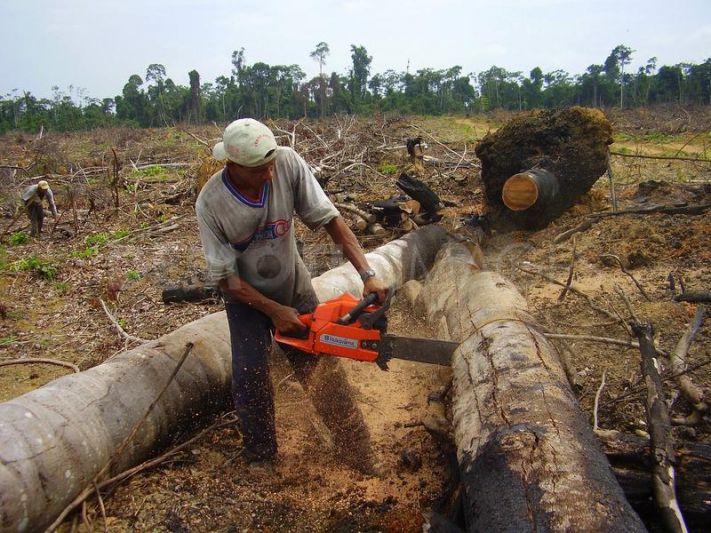 children. Viewers might wonder why these poor people have their backs against this kind of destructive employment wall, and why no other jobs are available to nourish both humans and their rain forest home.
Economist Michael Hudson states that rain forest destruction is directly tied into the Wall Street and London financial sectors. When Latin American countries in the early 1980s could no longer pay their debts, the International Monetary Fund advised them to sell off their water and oil rights, forests and subsoil mineral resources.
The tragedy of these policies are ongoing — and not only in Latin America — and have led to widespread poverty, hungry families, polluted water and joblessness.
David Suzuki, the Canadian geneticist, blasts this kind of economic system, saying it is “not based in anything like the real world.” Rather, he says, “it’s life, the web of life that filters water in the hydrologic cycle, it’s microorganisms in the soil that create the soil that we grow our food in. Economists call these externalities … that’s nuts!”
My television had barely cooled down from playing this film when the press reported Pope Francis addressing some of these terrible disparities during his mid-June interview [3] with the Spanish daily, La Vangardia.
 “The economy is moved by the ambition of having more,” he told the newspaper. The pontiff also observed “we are in a world economic system that isn’t good … we have fallen into a sin of idolatry, the idolatry of money.”
Francis also spoke of “discarding an entire generation to maintain an economic system that can’t hold up anymore,” ones which “sacrifice man at the feet of the idol of money.”
As I read the pope’s words, and thought back to scenes from “Surviving Progress” one of Pete Seeger’s songs, “Where have all the flowers gone?” surfaced in my heart.
“Oh, when will they ever learn?” goes the refrain.
Francis and the producers of “Surviving Progress” are singing the same refrain.
The author Wright adds his voice to their chorus, when he faces the camera and reflects:
“I think what we’re up again here is human nature, we have to reform ourselves, remake ourselves in a way that cuts against the grain of our, our inner animal nature and transcend that Ice Age hunter, that all of us are, if you strip off the thin layer of civilization.”
He concluded: “It’s up to us to prove nature wrong, in a sense, to show that we can take control of our own destinies and behave in a wise way that will ensure the continuation of the experiment of civilization.”
Source URL (retrieved on 06/24/2014 – 16:22): http://ncronline.org/blogs/eco-catholic/documentary-explores-historical-costs-surviving-progress
Links:
[1] http://www.survivingprogress.com/
[2] http://survivingprogress.com/wp-content/uploads/2012/03/SP_transcription.pdf
[3] http://larouchepac.com/node/31061
 to Holy Week and Easter — with Earth Day very soon thereafter —


 that gives way to adulthood. Each moment cells die to give space/opportunity for others. David S. Toolan, SJ, writes: We regrow our entire physical body as we do hair and nails. Nothing in our genes was present a year ago. The tissue of our stomach renews itself weekly, the skin is shed monthly, and the liver regenerates every six weeks. Every moment, a portion of the body’s 10[28] atoms is returning to the world outside, and ninety-eight percent of them are replaced annually. It’s automatic!


 ecospirituality resources