Archives

Weekend for Trafficking Victims

The last weekend in September — this year Sept. 26-27 — is International Weekend of Prayer and Fasting for Victims of Human Trafficking, be it trafficking for sex, labor (agriculture, textile, domestic, etc.), organs, or child soldiers. 2015 marks the 10th anniversary of this weekend initiated by the Salvation Army and the Initiative Against Sexual Trafficking (IAST). Anyone who believes that all life, all creation, is sacred will want to participate in this global effort of prayer and fasting to relieve this suffering endured by so many.

Although even the concept of human persons being treated as slaves — and worse — is repulsive, it occurs all over the globe, very probably in your area. Children, both boys and girls, are exploited.

Numbers 
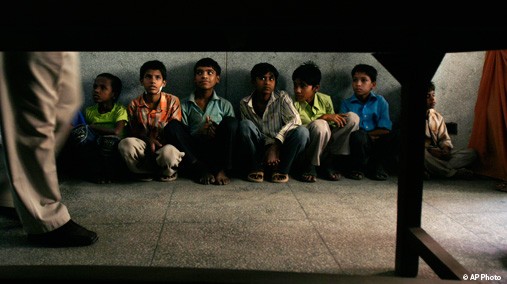
2010_0825_child_trafficking_mNumbers of trafficked persons are deceptive for two reasons. For one, accurate numbers are impossible to get — traffickers are not eager to share them and police cannot find them. The other is that numbers tend to be numbing. Learning that the International Labor Organization estimates that almost 21 million people are trafficked each year, or that 4.5 million of those exploited by individuals or enterprises are victims of forced sexual exploitation can be too big to comprehend by mind or heart. (http://www.ilo.org/global/topics/forced-labour/lang–en/index.htm)

Something tangible happens when we read that “two brothers, aged 7 and 10, died in April 2015 in a fire in one of the numerous clandestine garment workshops in Flores, a Buenos Aires neighborhood, where their parents, immigrants from Bolivia, were living and working.” (http://www.ipsnews.net/2015/05/garment-sweatshops-in-argentina-an-open-secret/) One might not WANT to picture the sweat shops, the fire, and the protection given to exploiters by police in return for bribes, but it is POSSIBLE to do so. Both mind and heart can grasp the death of two innocents, the pain of their parents, and the injustice aggravated by police corruption.

Or that Pariyar, a poor uneducated laborer in Nepal, was tricked into selling his kidney. He needed money, was lied to about what would be removed, was offered large sums (which never came), and so he agreed. He now has a urinary problem, no way to track down the sellers, cannot afford a trip to a doctor, and worries what will happen to his two children if he dies. (http://www.cnn.com/2014/06/26/world/asia/freedom-project-nepals-organ-trail/)

One Major Cause                                                                                                    Pope Francis leaves his general audience in St. Peter's Square at the Vatican Oct. 23. (CNS photo/Paul Haring) (Oct. 23, 2013) See POPE-AUDIENCE Oct. 23, 2013.

In July, Pope Francis told a meeting of the world’s Mayors that the  state of the environment is directly and intimately linked to the life and wellbeing of humankind. He said huge migratory waves of peoples across the globe are triggered by environmental issues such as

• desertification,
• deforestation,
• drought, and
• floods, which leave people and entire communities without the possibility of seeking a livelihood. Thus – he said – the exodus that takes them into urban centers gives life to human trafficking which brings with it diverse forms of exploitation of women, children and vulnerable people.  

Pope Francis mentions human trafficking three times in Laudato Si’: On Care for Our Common Home, always linking this issue with climate change and other results of the  destruction of our common home.

Prayer and Fasting Weekend

The focus on September 26-27, 2015, is on prayer and fasting, two simple actions that any reader of this blog can take to improve this blight on humankind. Uniting globally on the last weekend of September, our intentional and loving prayer and fasting “can do infinitely more than we can ask or imagine.” (Ephesians 3:20) But do imagine one of the many victims, and pray/fast/picture his or her release — especially if environmental destruction contributed to his or her plight. Pray and fast that this cause may be mitigated by response to Laudato Si’.

Solutions to human trafficking are many. For actions to reduce trafficking (that include prayer and a prayer service), go to https://ecospiritualityresources.com/2014/12/31/5-ways-to-reduce-human-trafficking/.

.    .    .    .    .

I add very sincere thanks to Jean Schafer, sds, editor of Stop Trafficking! (www.stopenslavement.org) who generously and graciously assisted with this blog and whose monthly newsletter is always a source of valuable information.
Our Father in Aramaic

I confess: my least favorite English prayer-phrase — Our Father who art in heaven — is from the very prayer that Jesus taught us: the Our Father. But I would have liked the Aramaic version Jesus undoubtedly used. The English translation comes from a time when people did not question patriarchy or a three-tiered world, and I don’t live there any more. In my experience, people can KNOW that “God is everywhere,” but they still look up when they refer to “him” because we are conditioned to picture a man in the sky. Keeping God above creation makes it harder for people, e.g., to understand Pope Francis’ words in Laudato Si’: “We do not only exist by God’s mighty power; we also live with him and beside him.” (72)

About the language Jesus used 

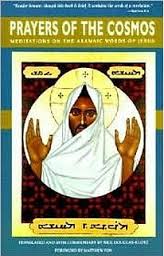
UnknownFortunately for me and others like Shirley Favot,* who delight in knowing that the language Jesus used harmonizes with the world as science now understands it, Neil Douglas-Klotz published Prayers of the Cosmos: Meditations on the Aramaic Words of Jesus (Harper & Row, 1990). He not only explains what the original Aramaic words mean, but explains the levels of meaning in the Aramaic language itself. He lets readers see the words written in Aramaic, he gives directions for saying them, and he offers suggestions for appropriate body prayers.
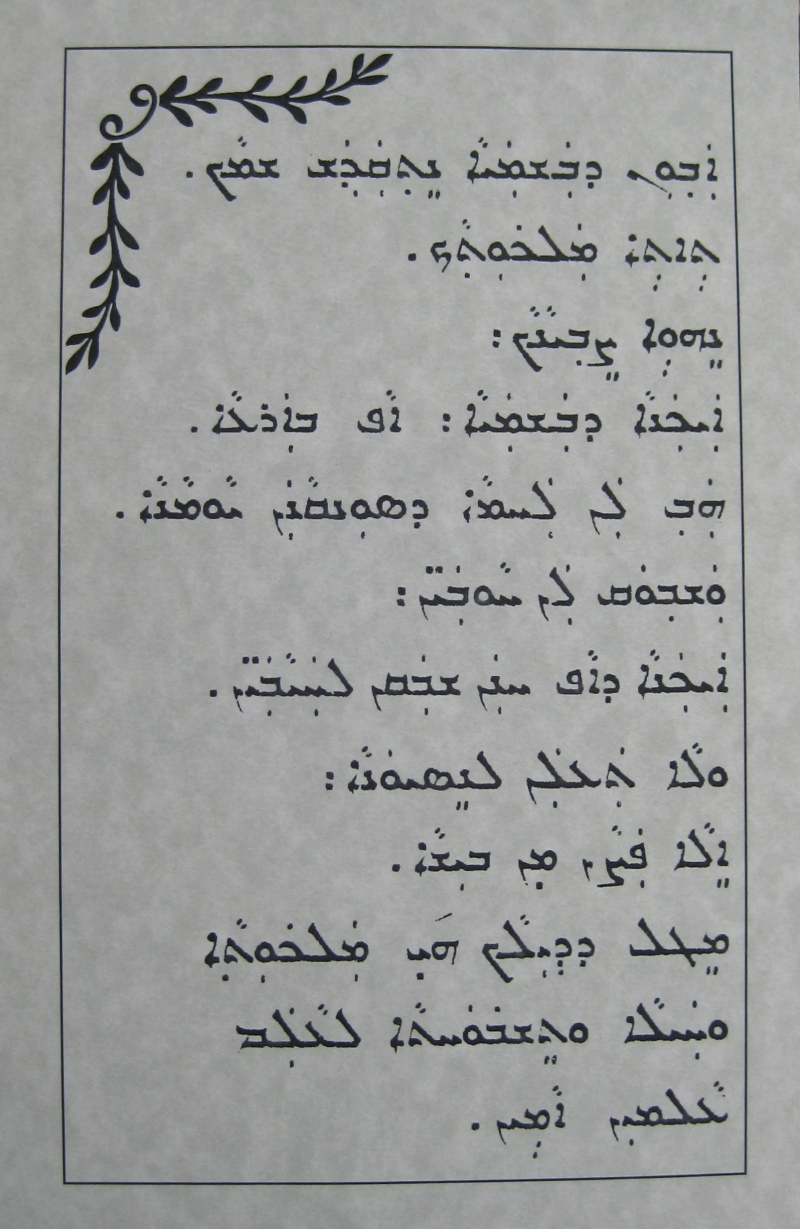
Douglas-Klotz tells us that each statement of sacred teaching must be examined from at least three points of view: the intellectual, the metaphorical, and the universal (or mystical). His phrase by phrase commentaries on the Our Father and the Beatitudes provide this rich fare. A very new question for me, when I read it shortly after its publication, was “What feelings do the sounds evoke?” He explains that body-resonance was important for those who first heard Jesus’ words.

“Heaven”

I was/am especially grateful for his explanation of “heaven” (which I included in Tuning to the  Divine: https://ecospiritualityresources.com/media/). “ ‘Heaven’ ” in Aramaic ceases to be a metaphysical concept  and presents the image of ‘light and sound shining through all creation.’ ” Wow!

“Father”

abwoon01aSo, if that’s what “heaven” meant to Jesus and his followers, what about the “Father” to whom he prayed? As he does with the others phrases, Douglas-Klotz offers a litany of possible translations. I appreciate them because I have long believed that, despite the advantages of using the metaphor “Father” for the un-nameable Mystery, its exclusive use contributes to anthropocentrism and to patriarchy/male dominance.

Additionally, using any one word exclusively for the unknowable can fool believers into thinking that they have captured the essence of the Mystery we also call God. This deprives believers of many other possibilities. Douglas-Klotz uses the following when translating Abwoon from the  Aramaic: Birther, Mother-Father, The Breathing Life of All, Source of Sound, Radiant One, Name of Names, Wordless Action, Silent Potency. While this list might not immediately appeal, trying other names — either to balance “Father” or to replace it temporarily — is sure to expand one’s understanding of the Holy One.

One Aramaic translation of the Our Father

What follows is the translation of the Our Father (KJV ) as found in Neil Douglas-Klotz’ Desert Wisdom: A Nomad’s Guide to Life’s Big Questions from the Heart of the Native Middle East (2010, ARC Books, www.abwoon.org), with gracious permission from the author:

O Breathing Life (Aramaic)

(an expanded, then condensed translation of Matthew 6:9-13 and Luke 11:2-4 from the Peshitta version of the Gospels)

O Breathing Life, your name shines everywhere!
Release a space to plant your presence here.
Envision your “I Can” now.
Embody your desire in every light and form.
Grow through us this moment’s bread and wisdom.
Untie the knots of failure binding us,
as we release the strands we hold of others’ faults.
Help us not forget our source,
yet free us from not being in the present.
From you arises every vision, power and song
from gathering to gathering.
Amen—May our future actions grow from here!


aramaic

*Shirley Favot, who lives in Canada, wrote: “I thought your website would be the perfect place to honour the deep story and to reclaim the “Aramaic Our Father” for us and for future generations . . . Jesus’ message of ‘The Companionship of Empowerment’ is so clear and hope-filled.” Since July 1st is Canada Day, I decided to post this for Shirley on that date.

Shirley first read the Aramaic Our Father on Diamuid O’Murchu’s web site under “Prayers”: http://www.diarmuid13.com/special-prayers. Neil Douglas-Klotz’ site is http://l.facebook.com/l/KAQHekVw4AQFX17J2pkuxfWJmCGZ5BeApUiwDsTlSk5d3Lg/www.abwoon.com

Who Are We (Becoming)?

Decades ago I heard a talk by Daniel C. Maguire that included a thought that deeply impressed me: that the missing link between apes and true humans is actually us! In Maguire’s Christianity Without God, I learned that this shape-shifting concept came from biblical scholar Gerd Theissen.

imagesI also like the title of an article by Walter J. Ong, SJ: “Where Are We Now?” Given all we’ve learned from physicists and cosmologists, we are not where, or who, we thought we were a century ago. The new context bumps us from our former self-understanding.

Our self-identity plays a key role not just in personal issues, but in the epochal transition of our time, as we leave one era and co-create the next one. Consider an insight found in Changing Images of Man (O.W. Markey and Willis W. Harman) that posits four levels of reality. Too often humans focus on identifying problems and how we deal with them. But this depends on what motivates us, which in turn results from our basic values and worldviews, the overarching stories that determine how we identify ourselves and others, including the divine and creation itself.

Willis and Markey use different sizes of wavy lines, but their insights work without them:

1. Substantive problems: What we see (e.g., poverty, pollution,
climate  change . . . .)

2. Process Problems: How we deal with these problems (e.g., deny, ignore, respond)

3. Normative Problems: What motivates us (e.g.,  acquiring wealth, concern for creation)

4. Conceptual Problems: What forms our values and motivations; What are our basic perceptions (e.g., our cosmic view, sense of identity, image of the divine, how these are interconnected)

The many creation stories of the major faith traditions (level 4) began when knowledge was intuitive: flat earth with a level above it, a level below it. No one questioned the true age of creation. Believers today must adjust their identities to the world as we now know it. Change challenges the mind and heart — but change we must, and the Mystery given many names is active within us to assist when/if we are open.

To start with perceptions of self: If our basic story convinces us that we are
– isolated from, and superior to, the rest of creation,
– on Earth temporarily to care only for humans, and
– here to earn a place in heaven above,
that percolates up into our values and decisions. As a result, we might not protect the  climate, air, water, soil, and other species upon which all life depends. We might  miss the new awareness that humans, divinity, and all creation form one distinct but interacting community that has evolved over billions of years. We might not appreciate that we are stardust webbed with the rest of known creation!

Berry3 for website Small wonder that Thomas Berry called for the reinvention of humanity at the species level! He famously said: The great work of our times is moving the human community from its present situation as a destructive presence on the planet to a benign or mutually enhancing presence.

Might this describe “true humans”? How did Jesus contribute to this reinvention?

Willow Harth expresses this new identity poetically. Despite her title, this is definitely for each of us:


This poem is not meant for you

This poem is not for you
unless you too have been underground
choking on your life’s debris, and
playing peek-a-boo with death seriously

then the surprise of ten thousand buttercups buttercup_field
out of nowhere on every side where they’d
never been before on my daily walk
might have had the effect on you it did on me

because suddenly

I wanted to understand how these particular
flowers came to be — the whole evolutionary
history of mosses, ferns, and angiosperms,
the miracle of photosynthesis and DNA, not

to mention the longings of the Milky Way
to reflect itself in the form called flowers and
in these buttercups, which seemed like a
visitation from the sun, urging me to tell you, in
case like me you had forgotten

we are the universe’s latest way of blooming.