Archives

A Pilgrimage to the Tar Sands

Guest blog by Mary Pendergast, RSM

“The disappearance of a culture can be just as serious, or even more serious, than the disappearance of a species of plant or animal.  The imposition of a dominant life-style linked to a single form of production can be just as harmful as altering ecosystems.”
#145  Laudato Si’

In July, I had the opportunity to go on a pilgrimage, a meaningful journey to a sacred place, in order to deepen my life’s purpose: to do the Great Work of our times. (Thomas Berry urged all of us over 30 years ago to engage in the Great Work of bringing forth a mutually enhancing Earth/human relationship.) Athabasca falls 1Sister Maureen Wild, SC, and I followed Athabasca River (in western Canada) from its source in the Columbian ice fields. We saw her acquire strength and power and tumble into the Athabasca Falls in Jasper  National Park. We observed some of the places where she had carved rock with torrents and rivulets a long time and where she flowed lazily through quiet towns sculpting a path north.  The Athabasca has one mission, to bless all life in its path with pure glacial water; but to do it she has to pass through hell.  She does not come out unscathed.

Maureen and I tailed the river to Fort McMurray, Alberta, Canada where she is used by the tar sands industry for its mining operation in the world’s last remaining “oil” field.  Second only to Saudi Arabia, the region is said to contain up to 2.5 trillion barrels of “oil,” but to get at it entails destroying an ecosystem and an indigenous way of life. The number one market for bitumen is the United States. 

To extract a barrel of bitumen requires the excavation of two tons of Earth and sand and three barrels of fresh water from the Athabasca.  That water use is equivalent to the water use of a city of two million people for a year!  Much of the water gets “recycled” in tailings ponds, used to settle out solids in the oil, water, chemical mix. The ponds are covered with the sheen of oil, so small cannons boom to keep birds from landing, 24 hours a day.  

If the “oil” is too deep to mine, the industry also uses another method of extraction called in situ.  It is a method that steams out the bitumen, but it burns natural gas to boil the water into steam.  Estimated use of natural gas in boiling water — enough to heat six million North American homes every day!   

Tar Sands mineIf this is beginning to sound like an energy intensive, unsustainable method to obtain bitumen which requires even more diluting and refining to become something that will actually flow through a pipeline, I think you are on to something!  Worst of all, each barrel of bitumen produces three times the greenhouse gas as conventional oil, putting us in the ever deepening hole of global emissions fueling climate change.

Maureen has First Nation elder friends in Fort McKay, Celia and Ed Harpe, who live just down river from the industry. They invited us to a dinner of moose meat and new potatoes.  They shared stories of their traditional way of life.  They no longer drink the water from the Athabasca, nor do they eat her fish which have been documented to have tumors, cancers and lesions, nor do they swim in the river or pick the berries and herbs growing wild.  They say that the wildlife has disappeared along with the forest and I wonder what the moose and the beaver are drinking wherever they are?  

Celia  is an outspoken critic of the Tar Sands industry. She says there have been no frogs on the river for 40 years. Canaries in the proverbial coal mine, they cannot survive in a toxic environment.  Tar Sands getty images 2The people, too, have come down with asthma and lupus and cancers I couldn’t even pronounce.  Celia said every family had someone who was sick, or already dead including her own. Her husband Ed has lung cancer. Her sister Dorothy died of lupus. Celia’s grandson, 32, was recently killed in an industry accident. We happened to be there for his memorial service.

 A way of life has been supplanted by an industry.  A people’s culture and health have been compromised. The people, caribou, bear, moose, fish and owl have to deal with a brew of heavy metals including arsenic, thallium and mercury in the Athabasca, while she continues her journey to the Arctic Ocean forever changed. 

The words of Thomas Berry ring as true as ever:

We might summarize our present human situation by the simple statement: that in the 20th century, the glory of the human has become the desolation of the Earth and now the desolation of the Earth is becoming the destiny of the human.

Mary at Climate MarchMary Pendergast, RSM has been Director of Ecology for the Sisters of Mercy Northeast since 2009. She is also involved with Mercy Ecology, Inc. A Montessori teacher for many years and singer with Carolyn McDade, she studied the New Story with Miriam MacGillis, OP at Genesis Farm. For more information and photos of Mary and her pilgrimage: www.riverpilgrims.net. Contact: mpendergast@mercyne.org

Blue Moon and Laudato Si’

I occasionally visit a club that was the venue for dances I attended as a teen-ager. As I enter, I “hear” the strains of “Blue Moon” — a song I would otherwise never think about. Because the next Blue Moon will be July 31st, I wondered if I could connect blue moons and a document I have been spending a lot of time with lately (cf. this site’s Lent resources) : Pope Francis’ encyclical, Laudato Si’.

Blue Moon, the Song

“Blue Moon, you saw me standing alone, without a dream in my heart, without a love of my own . . . and when I looked the moon had turned to gold!” I was happy to learn that composer Richard Rodgers and lyricist Lorenz Hart originally wrote the song in 1934 as “Prayer” for an MGM film in which it was ultimately not used. It had several other titles and lyrics, but the version we (at least we of a certain age) know became a hit in 1949 and again in 1961. But it truly began as “Prayer” — propitious for me as I begin this blog!

Blue Moon, the Astronomical Event          moon_8-31-2012_Priya_Kumar_Muscat_Masqat_Oman

In the current definition, the term Blue Moon refers to a second full moon within a calendar month, an event that occurs once every two or three years. The identity of the moons was important in the ecclesiastical calendar (think Lent and Easter), and a year with a 13th moon complicated the process. There were names for only 12 moons. By identifying the 13th moon as a blue moon, the ecclesiastical calendar was able to stay on track.

The extra moon is rarely blue, a phenomenon that can be caused by the type of dust or smoke particles in the air that scatter blue light. I could not find the origin of why the extra moon was called blue, but it works well for this blog.

Sister Blue Moon and Laudato Si’

The popular expression “once in a blue moon” and lyrics in the haunting melody draw me to make a few connections between Blue Moon and Laudato Si’. Pope Francis’ encyclical is titled, begins with, and consistently builds on St. Francis of Assisi’s belief that all creation is one and each part is brother and sister to us. After Brother Sun, Francis mentions Sister Moon and stars, followed by Brothers Wind and Air, Sister Water, Brother Fire, culminating with Sister Earth, our mother. (So, I shall refer to Sister Blue Moon.) These constitute our Common Home for which Laudato Si’ implores our care.

That our Common Home is in big trouble is not news to readers of this blog. We might well feel “blue” when we consider all the problems Earth, with everyone and everything whose lives are  interconnected as part of it, face at this critical time.

Once in a Blue Moon

The Pope’s encyclical falls into that category, although it follows a splendid line of papal social encyclicals that began in 1891 with Pope Leo XIII’s Rerum Novarum on the Rights and Duties of Capital and Labor.  This encyclical is the first not to be titled in Latin, but in Italian. It is the first encyclical to be written on this topic (though many popes have written in concern for the environment and the poor). It is the first to be written by a Jesuit Pope, as Pope Francis has that distinction. It is the first to use inclusive language. It is the first to quote from not-Catholic sources such as the Earth Charter. And arguably it is the first to have received such interest, pro and con.

you saw me standing alone

Standing alone is one of the causes Pope Francis singles out as contributing to the devastation presently causing many to feel blue. (Not his words, of course!) Throughout the document he urges us to act in community and for the good of the global community: the common good, especially the poorest people and poorest parts of our interconnected common home. He recognizes, both from science and experience, how closely we are interconnected with one another and with all creation to follow us. Isolation does not exist in nature. No one is standing alone!

without a dream in my heart

Without a vision, the people perish, indeed. Pope Francis envisions a new economic and ecological world order where the goods of the Earth are shared by everyone, not just exploited by the rich. He echoes Thomas Berry’s hope for a community of subjects forming an emerging epoch when humanity would live in a mutually enriching relationship with the larger community of life on Earth. Was this not Jesus’ vision expressed in the Gospels? We have the dream in our hearts!

without a love of my own

Pope Francis consistently calls us to love one another, the “other” being all the rest of creation, especially the poor and disadvantaged. He uses the word “love” more than 70 times! He reminds us that it was God’s love that gave us this creation in the first place ( and ongoing) and that all of our Scripture writings tells us of the love that God has for us. We have a love of our own, but love by its definition must be shared!

when I looked the moon had turned to gold!

golden-moonGold symbolizes wealth used wisely. It is also the symbol of good health. We readers and implementers of Laudato Si’ might take it as a reminder of our call to turn this ailing world into a just and healthy common home, where wealth and the resources needed to acquire it are shared for the common good and the result is health for humans and all life on our endangered planet.

No matter what color we see when we look at Sister Moon, let us unite with others, keep clear the vision, and act in love to create a world where wealth is used wisely and people and planet gain their health.  To paraphrase St. Francis’ Canticle: All praise be Yours, my Lord, through Sister Blue Moon — and may we consistently act together to turn it to gold!

P.S.

I cannot omit St.Ignatius Loyola in this blog. His feast is celebrated on July 31st and his renowned Spiritual Exercises begin and end with a contemplation on divine love as experienced through all creation. It doesn’t seem a stretch to suppose that these meditations influenced our first Jesuit pope and his first encyclical.

Our Father in Aramaic

I confess: my least favorite English prayer-phrase — Our Father who art in heaven — is from the very prayer that Jesus taught us: the Our Father. But I would have liked the Aramaic version Jesus undoubtedly used. The English translation comes from a time when people did not question patriarchy or a three-tiered world, and I don’t live there any more. In my experience, people can KNOW that “God is everywhere,” but they still look up when they refer to “him” because we are conditioned to picture a man in the sky. Keeping God above creation makes it harder for people, e.g., to understand Pope Francis’ words in Laudato Si’: “We do not only exist by God’s mighty power; we also live with him and beside him.” (72)

About the language Jesus used 

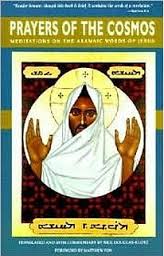
UnknownFortunately for me and others like Shirley Favot,* who delight in knowing that the language Jesus used harmonizes with the world as science now understands it, Neil Douglas-Klotz published Prayers of the Cosmos: Meditations on the Aramaic Words of Jesus (Harper & Row, 1990). He not only explains what the original Aramaic words mean, but explains the levels of meaning in the Aramaic language itself. He lets readers see the words written in Aramaic, he gives directions for saying them, and he offers suggestions for appropriate body prayers.
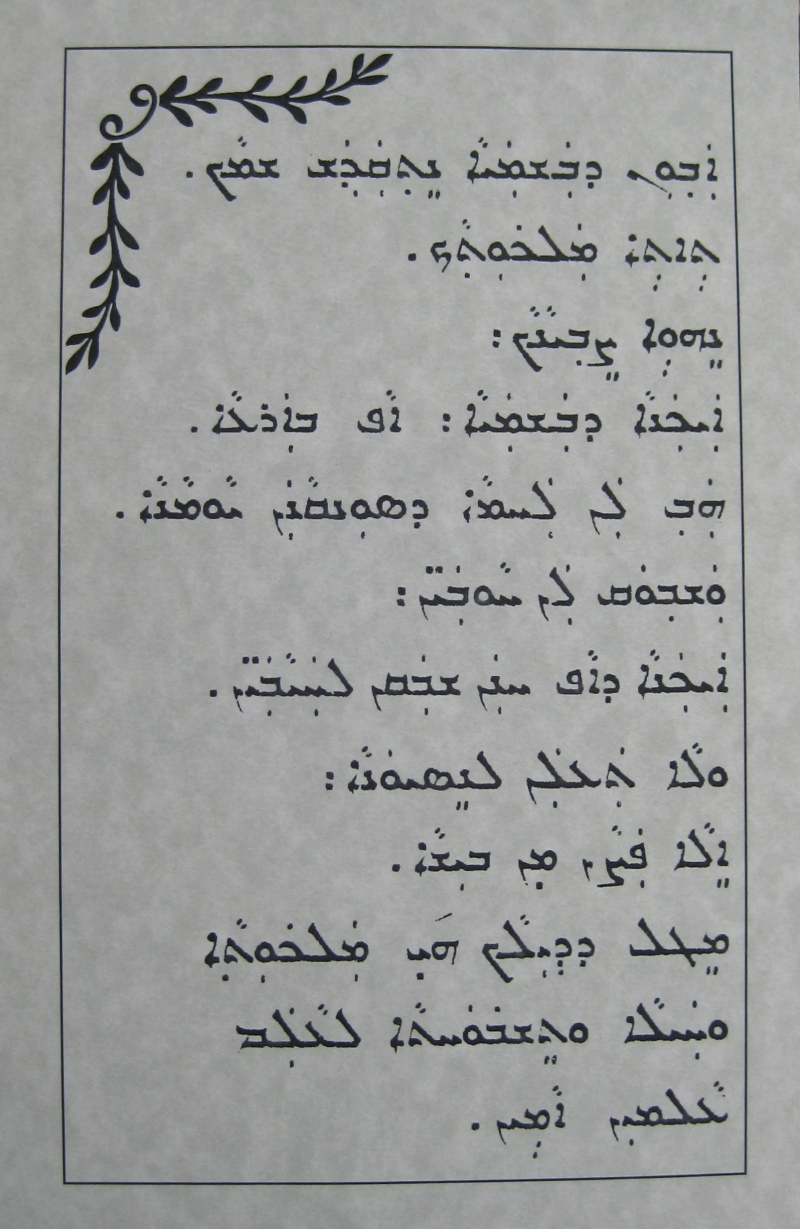
Douglas-Klotz tells us that each statement of sacred teaching must be examined from at least three points of view: the intellectual, the metaphorical, and the universal (or mystical). His phrase by phrase commentaries on the Our Father and the Beatitudes provide this rich fare. A very new question for me, when I read it shortly after its publication, was “What feelings do the sounds evoke?” He explains that body-resonance was important for those who first heard Jesus’ words.

“Heaven”

I was/am especially grateful for his explanation of “heaven” (which I included in Tuning to the  Divine: https://ecospiritualityresources.com/media/). “ ‘Heaven’ ” in Aramaic ceases to be a metaphysical concept  and presents the image of ‘light and sound shining through all creation.’ ” Wow!

“Father”

abwoon01aSo, if that’s what “heaven” meant to Jesus and his followers, what about the “Father” to whom he prayed? As he does with the others phrases, Douglas-Klotz offers a litany of possible translations. I appreciate them because I have long believed that, despite the advantages of using the metaphor “Father” for the un-nameable Mystery, its exclusive use contributes to anthropocentrism and to patriarchy/male dominance.

Additionally, using any one word exclusively for the unknowable can fool believers into thinking that they have captured the essence of the Mystery we also call God. This deprives believers of many other possibilities. Douglas-Klotz uses the following when translating Abwoon from the  Aramaic: Birther, Mother-Father, The Breathing Life of All, Source of Sound, Radiant One, Name of Names, Wordless Action, Silent Potency. While this list might not immediately appeal, trying other names — either to balance “Father” or to replace it temporarily — is sure to expand one’s understanding of the Holy One.

One Aramaic translation of the Our Father

What follows is the translation of the Our Father (KJV ) as found in Neil Douglas-Klotz’ Desert Wisdom: A Nomad’s Guide to Life’s Big Questions from the Heart of the Native Middle East (2010, ARC Books, www.abwoon.org), with gracious permission from the author:

O Breathing Life (Aramaic)

(an expanded, then condensed translation of Matthew 6:9-13 and Luke 11:2-4 from the Peshitta version of the Gospels)

O Breathing Life, your name shines everywhere!
Release a space to plant your presence here.
Envision your “I Can” now.
Embody your desire in every light and form.
Grow through us this moment’s bread and wisdom.
Untie the knots of failure binding us,
as we release the strands we hold of others’ faults.
Help us not forget our source,
yet free us from not being in the present.
From you arises every vision, power and song
from gathering to gathering.
Amen—May our future actions grow from here!


aramaic

*Shirley Favot, who lives in Canada, wrote: “I thought your website would be the perfect place to honour the deep story and to reclaim the “Aramaic Our Father” for us and for future generations . . . Jesus’ message of ‘The Companionship of Empowerment’ is so clear and hope-filled.” Since July 1st is Canada Day, I decided to post this for Shirley on that date.

Shirley first read the Aramaic Our Father on Diamuid O’Murchu’s web site under “Prayers”: http://www.diarmuid13.com/special-prayers. Neil Douglas-Klotz’ site is http://l.facebook.com/l/KAQHekVw4AQFX17J2pkuxfWJmCGZ5BeApUiwDsTlSk5d3Lg/www.abwoon.com