Carmel Bracken RSM*, is the author of this guest blog, with Laudato Si’ addition from me.
Hidden Wholeness
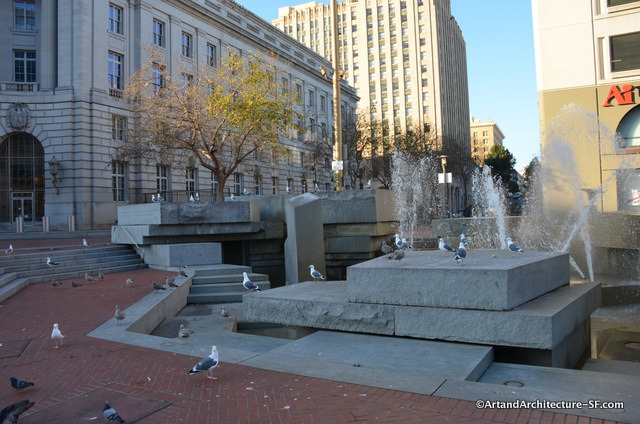 In the heart of the Civic Centre of San Francisco there is a beautiful fountain which has two quotations etched on it. One quote by Franklin D. Roosevelt is written in a very prominent position and states that ‘The structure of world peace cannot be the work of one man, or one party, or one nation …. it must be a peace which rests on the cooperative efforts of the whole world.”
The second quote by John Muir reads ‘If you try to pick out anything at all in the universe you will find it hitched to everything else.’ This is written on a slab of stone that is underneath the water and easy to miss. For me this is very symbolic, that of the two quotations this was the one placed in a deeper, underwater place. It reminds us that we need to do deep soul work to uncover the hidden wholeness of all of life and that only by living from an awareness of unity consciousness, will we truly know how to co-operate with each other and all of life.
Essential Unity
Science is now offering us proof of what John Muir intuitively understood and what the mystics knew for generations, that “at our essence we exist as a unity, a relationship utterly interdependent, the parts affecting the whole at every moment…”
 Pope Francis makes this point again and again in Laudato Si’. For one example:
It cannot be emphasized enough how everything is interconnected. Time and space are not independent of one another, and not even atoms or subatomic particles can be considered in isolation. (par. 138)
How do we embody this wisdom? What are its implications? Mercy Sisters have asked themselves this in their Chapter question “In what ways will we allow our place in the interdependent and interconnected community of all of life to influence us?”
Subtle Activism
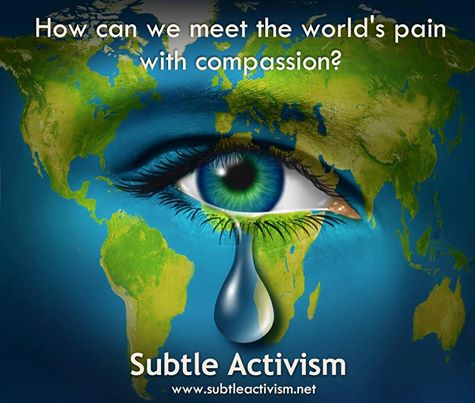 In trying to live into this question, I found myself exploring the path and potential of subtle activism, which is based on an awareness that “every improvement we make in our private world improves the world at large for everyone.” Subtle activism is any “activity of consciousness or spirit, such as prayer, meditation …. intended to support collective healing and social change.” Subtle activism influences social change through the inner or subtle plane, rather than through conventional exterior means like marches, demonstrations, lobbying, etc.
The potential for subtle activism is only beginning to be tapped. As breakthroughs in quantum physics began to reveal “the unified field of universal intelligence at the basis of mind and matter” a number of scientific projects began to explore the effects of intention and meditation. A study in Washington DC showed there was a decrease in crime for a two month period in which 4,000 people gathered to meditate. Intention experiments — “a series of scientifically controlled, web-based experiments testing the power of intention to change the physical world” — have produced extraordinary results. Findhorn experiments showed how “positive thoughts improved the growth of plants, and Masaru Emoto’s experiments showed how human emotions effect the nature and composition of water.”
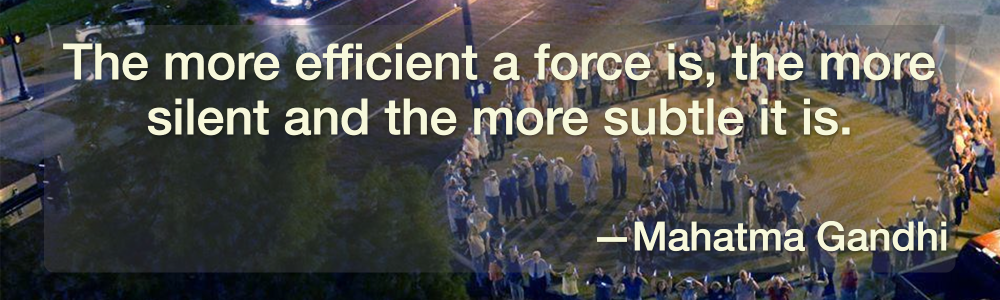
Subtle activism does not replace action in the world, it just extends the range of options open to an activist who is awake to a holistic and integral vision of reality where “the subtler, inner dimension of human experience is being reclaimed.” It can be a means of making a contribution to social change for those who no longer have the physical stamina for action in the outer world and for “people of a certain temperament, or who possess certain spiritual gifts.”
Subtle activism is deeply challenging for it calls us to live from a place of awareness, knowing that “Every thought, action, decision or feeling creates an eddy in the interlocking, inter-balancing, ever-moving energy fields of life, leaving a permanent record for all of time….” Subtle activism is not about telling others what to do, but a call to embody whatever quality we wish to see in the world, to “be whatever it is we ‘send’ out.” This is implicit in Ghandi’s call to “Be the change you wish to see in the world.”
1 Lynn McTaggart, The Bond
2 David Hawkins, Power Versus Force
3 Gaiafield project
4 John Hagelin
5 Robert Moss
6 David Nicol
7 David Spangler
8 David Hawkins, Power Versus Force
9 David Spangler
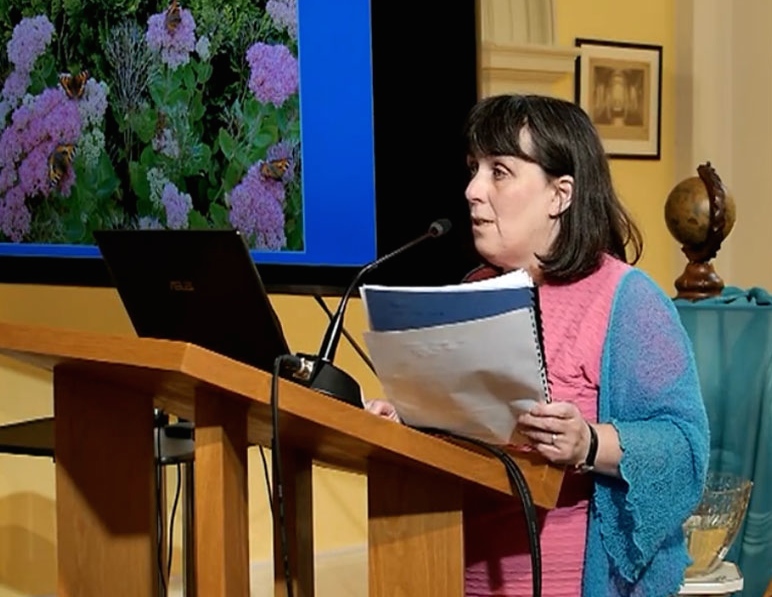 *Carmel Bracken is a member of the Irish Congregation of Sisters of Mercy, Northern Province. A member of their Mercy Global Action Network (MGAN), Carmel received an MA in Culture and Spirituality in Sophia Center in Oakland, California. She has inspired me with her writings and presentations, and I am grateful for this blog.
 Laudato Si’, the Encyclical
 interested in participating in this dialog. (The encyclical is addressed to everyone, any religion.) This resource integrates the Pope’s words with Lent’s Sunday Scripture readings. Pertinent videos and music enhance the content so that the words reach both head and heart.


 ecospirituality resources