Teilhard de Chardin

Pierre Teilhard de Chardin, SJ (1881 – 1955)

 You might have seen this blog before, as I originally posted it last summer.  A mysterious technical problem arose, resulting in my receiving dozens of comments that were about other topics, all with the Teilhard de Chardin heading. Perhaps there was a better way to handle this, but my solution was to temporarily take it offline by making it a Draft. That stopped the irrelevant and weird comments, but I didn’t want to keep it offline forever.
(Discussion/Reflection questions are at the end.)images
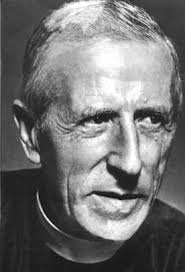
 
I recently had a conversation with a person who gave, as an example of someone who had wasted his life’s energy writing obscure books, Pierre Teilhard de Chardin. Well, one man’s opinion. 
 
My take on Teilhard is that his writings, though misunderstood by those in authority (who warned the faithful about them as lately as 1981) have probably influenced the lives and thinking of all Christians exploring science and religion, matter and spirit, faith and the Universe Story. If you’ve been impacted by Thomas Berry or Mary Evelyn Tucker, or many others who share a similar vision, you have experienced the influence of this French Jesuit. Many of my contemporaries— and possibly the present reader —  were thrilled by reading  his manuscripts in their youth. Most of us have read at least one of his books. Many are familiar with quotes from him and have experienced over time the wisdom his words hold. They are profound, they are challenging, they are pregnant with life and love. 
Of possible interest to SHCJ: Soeur Marie St. Jean Teillard-Chambon, SHCJ, was a cousin of Pierre!

WHAT
 FOLLOWS IS A SAMPLING OF QUOTES: The first two are a transition from my last blog, about exploration into God.
I am more and more convinced that the great event of our time is a kind of change in the face of God in which the pure “God of above” of yesterday is being combined with a kind of “God of ahead.” 
 
Not “God who is dying,” as Nietzsche said, but “God who is changing.”
To those who know how to see, nothing is profane. 
 
By his Incarnation [Christ] inserted himself not just into humanity but into the universe which supports humanity.
The consciousness of each of us is evolution looking at itself and reflecting upon itself. (I heard that first from Miriam Therese MacGillis, OP, in 1979. It sailed high over my head, but somehow I felt called to comprehend it. This took me well-spent years!)
 
Because it is not sufficiently moved by a truly human compassion, because it is not exalted by a sufficiently passionate admiration of the universe, our religion is becoming enfeebled.
(That was written in 1918!)
 
 [About the “other” who usually appears a danger, nuisance, and obstacle:] I shall like them as soon as I see them as partners in the struggle.
 Do not brace yourself against suffering. Try to close your eyes and surrender yourself as if to a great loving energy. This attitude is neither weak nor absurd, it is the only one that cannot lead us astray. 
 
Unquestionably, Jesus is still he who bears the sins of the world; in its own mysterious way suffering makes reparation for moral evil . . . The full and ultimate meaning of redemption is no longer seen to be reparation alone, but rather further passage and conquest. 

 
images-2The presence of the Incarnate Word penetrates like a universal element. It shines at the heart of all things.
 
There is almost a sensual longing for communion with others who have a large vision. The immense fulfillment of the friendship between those engaged in furthering the evolution of consciousness has a quality impossible to describe.
 
Love is the most powerful and still the most unknown energy of the world.
 
The day will come when, after harnessing space, the winds, the tides, and gravitation,
we shall harness for God the energies of love. And, on that day, for the second time in the history of the world, we shall have discovered fire.
 
A prayer
 
When the signs of age begin to mark my body (and still more when they touch my mind);
when the ill that is to diminish me or carry me off strikes from without or is born within me;
 when the painful moment comes in which I suddenly awaken to the fact that I am ill or growing old;
and above all at that last moment when I feel I am losing hold of myself and am absolutely passive
within the hands of the great unknown forces
 that have formed me;
 
in all those dark moments, O God, grant that I may understand that it is you 
(provided only my faith is strong enough) who are painfully parting the fibres of my being
in order to penetrate to the very marrow of my substance and bear me away within yourself.
Possible discussion/reflection starters:
I had hoped to keep the quotation list brief, but I was unable to do so. Which one(s) might you have omitted and why? images-1
If you had to limit them to three, which ones would you have chosen and why?
If you have a favorite that is missing, please add it to the comments!
If you have found “communion with others who have a large vision,” how do you nurture it?
 
 
For more, see 
teilharddechardin.org/
http://www.teilhard.com
www.teilhardproject.com
Blanche Gallagher’s Meditations with Teilhard de Chardin, Bear and Company, 1988
Arthur Fabel, Donald St. John, ed., Teilhard in the 21st Century: The Emerging Spirit
of Earth, Orbis, 2003
Any book written by Teilhard  (The Phenomenon of Man is now titled The Human Phenomenon.)
Extinction Grieving Prayer

Those who are “joined … so closely to the world around us that we can feel the … extinction of a species as a painful disfigurement” (Pope Francis) often feel, and sometimes read about, the need for a prayer or ritual to help us grieve. I felt that need especially after researching and writing my last two blogs.

My Lent 2015 Creation Covenant resource concludes its five weeks with a grieving prayer, but that does not fill an immediate need. I have found no prayer or ritual on the internet for this purpose and can find no national or international day of mourning for extinct species or ruined ecosystems.  (Please let me know if you find one or both.)

I wrote what follows for myself and anyone else who wants to use it on whatever day or whatever occasion seems fitting. By all means alter it in any way that will help you grieve, alone or with a group. Share freely.

For a two page (4 sides) copy of the prayer: Extinction Grieving Prayer.

~   ~   ~   ~   ~   ~   ~   ~   ~   ~

EXTINCTION GRIEVING PRAYER

Use two candles; prepare suggested (or other) music and video. Directions are starred. Adapt in any way that facilitates use. 

CALL TO PRAYERsparrow-dusky_seaside_sparrow-from-wikipedia

. . .today, the dusky seaside sparrow
became extinct. It may never be as famous
as the pterodactyl or the dodo,
but the last one died today . . . .
An excerpt from “Science” by Alison Hawthorne Deming

What you call resources, we call our relatives. Source unknown.

* Light the first candle. It honors all the species that have gone extinct in our lifetimes.

Great Giver of Life, we pause to remember our place at the beginning of the Sixth Great Extinction on Planet Earth. For 13.8 billion years creation has been groaning: bringing to birth, becoming more complex, more organized, more conscious. The other great extinctions during the past 450 million years happened by forces beyond anyone’s control. Now, for the first time, our species is ruining whole ecosystems, aborting entire interdependent species. We acknowledge that we play a part in this dying by our carelessness, ignorance, and indifference. Forgive us our part in the death of healthy ecosystems and the resulting extinction of creatures in whom we believe divinity lives and acts.

LITANY OF AFFIRMATION

imagesWe affirm the Sacred Mystery that caused and continues Creation.

We affirm the 13.8 billion years of our Universe.

We affirm the billions of galaxies, each with its billions of solar systems and stars.

We affirm the multiple transformations during the 4.5 billion years of Mother Earth’s life so far, and the relentless evolution towards ever-greater consciousness in the future.

We affirm the millions of species that have inhabited our planet in beautifully-webbed communities: microorganisms, plants, fish, birds, mammals . . . .

We affirm that we came from Earth and exist, like all species, in a communion of subjects.

LITANY OF GRIEF

We grieve humans’ lack of awareness of, and concern about, the destruction of interdependent communities that have taken billions of years to develop.

We grieve the climate disasters that extinguish habitats and the multiple species within them.

We grieve the more than one-in-four flowering plants, the one-in-five mammals, the nearly one-in-three amphibians, and the one-in-eight birds that are vulnerable to being wiped out completely. (International Union for the Conservation of Nature)img_18-tm

We grieve the Golden Toad (pictured here), native to Costa Rica. It has not been seen since 1989, when a single male was found, the last of its species.

ibex1-tmWe grieve the Pyrenean Ibex (pictured here). The last of this species naturally born was a female, Celia, who died in 2000.

We grieve the St. Helena Olive, images-1a small spreading tree, the last of which perished in 2003 primarily due to deforestation and invasive plants.

We grieve all our extinct brother and sister species, the amphibians, fish, birds, mammals, plants and trees, and their diminished habitats.

We grieve the humans whose sustenance and livelihoods are threatened by this disruption in the food web.

We grieve the deaths of ecological martyrs: Sister Dorothy Stang, Dian Fossey, Chico Mendes, and the over 900 other activists slain since 2004. (Global Witness)

* LISTEN TO or SING:

“Where Have All the Flowers Gone?” Perhaps for v. 2 and 3: species, workers.  (If needed, Joan Baez’ version: http://www.youtube.com/watch?v=0LZ2R2zW2Yc.)

* Extinguish first candle. Light second candle. It honors the threatened species that remain and our desire to protect them. 

* QUIET REFLECTION: 

For believers, our faith is tested by our concern and care for creation. U. S. Catholic Bishops: “Renewing the Earth” 1991

* WATCH:
How wolves renewed Yellowstone Parkimages-2
http://www.youtube.com/watch?v=bh_fdfIPvDg.

LITANY of GRATITUDE and HOPE 

We are grateful that 90% of species under the protection of the Endangered Species Act (U.S.) are recovering at the rate specified by their federal recovery plan.

0611.Rugendo_in_bukima.150We are grateful that British oil company Soco International agreed (June 2014) to suspend exploration in a national park in the Democratic Republic of Congo (DRC), home to half the world’s critically endangered mountain gorillas (pictured here) and thousands of other species. We thank the over 750,000 people who signed a petition to stop the oil drilling.

We are grateful that the Zoological Society of London released its list of birds most at risk of extinction based on evolutionary distinctness and global endangerment (EDGE) in April 2014. This information will help conservationists decide where efforts should focus first.

We are grateful that the population of the California Least Tern californialeasttern_flickrcommons_USFWS-Pacific-Southwest-Region(pictured here), listed as endangered in 1970, grew from 225 recorded then to 6,568 recorded in 2010.

We are grateful for all of the habitats that have been saved so that the interdependent species within them can escape extinction.

We are grateful for the many people throughout the world who dedicate their time and efforts to keeping habitats and species alive so they can give praise to their creator by their distinct lineages, attributes, and contributions to the web of life.

ACTION SUGGESTIONS

Let us not leave in our wake a swath of destruction and death which will affect our own lives and those of future generations.  Pope Francis

To save species, we must save ecosystems. To save ecosystems, we must reduce climate change, pollution, poaching, invasive species, and over-consumption. Mentally check the things on p. 4 that you already do. There might be something else there that you would want to do.

* READ QUIETLY:

 Consciously deepen appreciation of the glory of creation, its long story, the place of Divine Mystery in it, and humans’ dependence upon it.      Pray for the healing of creation.

Reduce all energy use.      Transition to renewable energy sources (for electricity).

Encourage institution to invest in renewable energy and to divest from fossil fuels.

Drive less and/or reduce gas use by not exceeding 60 mph on the highways (and other ways).

Avoid produce, meat, and poultry from factory farms.      Buy recycled products.

Reduced use of plastic.          Carry water in a thermos (not bottled water).            Buy local.

Avoid genetically modified foods (GMOs).      Lobby for laws to protect habitats and species.

Include Earth-care concerns when choosing legislators.

Join (or cooperate with) a group working to conserve, restore and protect habitats and species.

* DISCUSS:

Einstein said: Imagination is more important than knowledge. Knowledge points to all that is. Imagination points to all that could be.  What kind of Earth “could be”? How can we contribute to co-creating it?

SENDING FORTH

Great Giver of Life, we come from, and we dwell in, the magnificent world in which you live and act. Our species is causing extinctions; our species can prevent them. Let us not be thwarted by the immensity of the challenge, for the Power working within us can do more than we could imagine. May the flame of this candle continue burning in our hearts, reminding us to help our threatened relatives.

* Extinguish second candle.

Enlighten us to find you in all Creation; empower us to treat it accordingly. Through Jesus Christ, whose respect for Earth inspires us to live as he did. Amen.

* SING:

“The Heavens Are Telling the Glory of God” or “Touch the Earth” (Kathy Sherman, CSJ) or another appropriate song

* SHARE

a sign of hope with one another (or a sign of peace).


LEARNING FROM EXPERIENCE

My last blog shared insights about saving species: that a key factor is to think ecosystems rather than merely focus Earth-Hands-imageon isolated species — even though they are easier to image and more likely to motivate us to action. We need to develop the consistent ability to “see” interconnections and protect entire habitats.

Thomas Berry always said that nothing is itself without everything else. This might be especially pertinent when thinking about the species closest to our hearts: the one containing human hearts. Thomas also said that reinventing the human was part of the Great Work of our time. Pope Francis’ recent statements seem to agree.

Eco Catholic blog 

100_0022-2Sharon Abercrombie’s 6/24/14 blog on the National Catholic Reporter (NCR) site (http://ncronline.org/node/80236) caught my attention. Small wonder. Here’s how she begins:

True or false? Our current ecological crisis is a completely new development in the history of humankind — a situation only 200 years old, a nasty byproduct of progress fostered by the Industrial Revolution. 

If you voted “true,” that’s just a bit false. It’s not the whole story.

To get the full picture, take a gigantic leap back into time beginning with the Old Stone Age. Those ancestors content to kill just two mammoths instead of one were still behaving sustainably. But the ones who took the shortcut approach by driving entire herds over a cliff, were eventually defeated by their own “progress,” running out of a major food source for their lunches.

Sharon continues with insights from Surviving Progress [1]”: a 2011 film directed by Mathieu Roy and Harold Crooks, and with Martin Scorcese among its executive producers. “Surviving Progress” tells us where we’ve been and where we are going ecologically as a species. It warns that the outcome for us and the rest of the planet will be disastrous unless we melt down the edges of our Ice Age mentalities with an expanded, inclusive moral consciousness. I highly recommend this powerful documentary for summer spiritual televiewing (A complete transcript [2] is also available on the film’s website).

I like to imagine the interconnections of the various individuals within these civilizations rather than thinking solely about the humans (in a lump sum) and their accomplishments. The facts and theories are the same, but new light is shed when we remember how interconnected each human was with everything and everyone else within its biosystem: from microorganisms to other humans, from soil to water to air, from climate to lifestyles . . . .

Extinct Civilizations

Recent reports about climate change impel responsible humans to consider prayerfully the implications of global ecosystemolmec-civilization-disappeared collapse and the fact that it could imperil all species as well as the future evolution of planet Earth.

At least ten, probably more, thriving civilizations have disappeared from various locations on Earth, many prior to the Christian Era (BCE). One wonders what individuals in these civilizations thought as their ecosystem became threatened. Denial? Trust in the gods? Futile blame-games? Resignation? 

Top theories for extinctions of civilizations include invasion and ecological causes like volcanic eruptions, climate changes leading to drought, and over farming or over hunting causing starvation. Extinction won. This need not happen again if we learn from the past.

“Surviving Progress”

NCR has graciously allowed me to reprint Sharon’s blog, and the rest is hers:

“Surviving Progress” features authors, environmentalists, historians and economists and includes such notables as David Suzuki, Ronald Wright, Margaret Atwood, Jane Goodall and Stephen Hawking. Activists from the Congo, Canada and the United State complete the cast.

Viewers will come away with their own particular memories, but one of mine was the realization that ancient Rome became an early prototype for our current economic system — the wealthy minority at the top of the pyramid versus the rest.

In those days, it was the custom for Sumer, Babylonia, Egypt and other countries to occasionally cancel their debts when they became too unwieldy. This policy created a clean slate so that societies could start afresh.

imagesRome, however, did not approve of such mercies, instead waging war with kings unable to pay their debts, explained economist Michael Hudson. Like plagues of locusts, Roman legions stole gold from the temples and public buildings, stripped cities of their waterworks, and created a desert from the land.

“A debt is a debt,” became the Roman calling card. Egalitarian lands, where peasants formerly had access to public land, were taken over by the lords and generals. This move helped to create widespread homelessness, the creation of slums and ecological problems.

Canadian author Ronald Wright, whose book A Short History of Progress inspired the film, explained that erosion became a serious problem, “so bad that some of the Roman ports silted up with all the topsoil that got washed down from the fields into the river.”

Archeologists in Italy have been able to measure the degradation caused by Rome’s fall, said Wright, adding that they also discovered “how it took a thousand years of much reduced population during the Middle Ages for fertility in Italy to rebuild.”

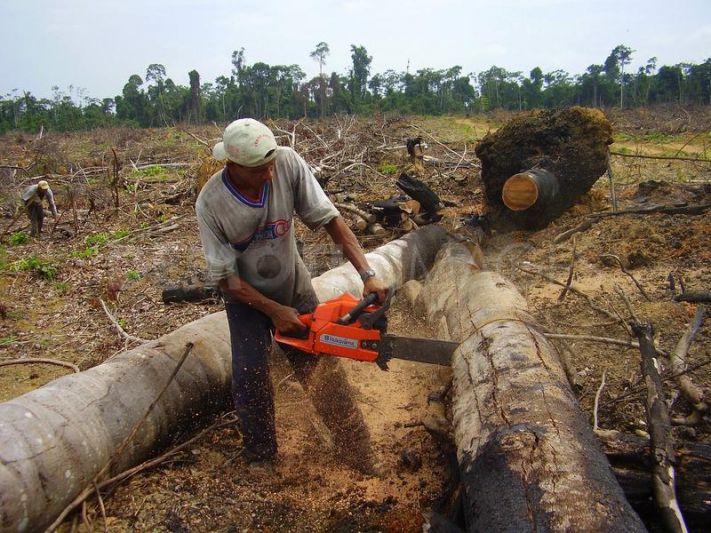
Of the saddest portions of the documentary are scenes from the Brazilian rain forest, burned and clear cut by logging companies. At one point, the camera closes in on a half standing tree, with a lone dying insect, struggling to hang on, trembling, shaking and trying to figure out what has just befallen it.

Meanwhile, back at the lumber mill, families speak of the necessity of such work in order to feed themselves and their 1384791420-rise-in-deforestation-in-the-amazon-rainforest-_418266children. Viewers might wonder why these poor people have their backs against this kind of destructive employment wall, and why no other jobs are available to nourish both humans and their rain forest home.

Economist Michael Hudson states that rain forest destruction is directly tied into the Wall Street and London financial sectors. When Latin American countries in the early 1980s could no longer pay their debts, the International Monetary Fund advised them to sell off their water and oil rights, forests and subsoil mineral resources.

The tragedy of these policies are ongoing — and not only in Latin America — and have led to widespread poverty, hungry families, polluted water and joblessness.

David Suzuki, the Canadian geneticist, blasts this kind of economic system, saying it is “not based in anything like the real world.” Rather, he says, “it’s life, the web of life that filters water in the hydrologic cycle, it’s microorganisms in the soil that create the soil that we grow our food in. Economists call these externalities … that’s nuts!”

My television had barely cooled down from playing this film when the press reported Pope Francis addressing some of these terrible disparities during his mid-June interview [3] with the Spanish daily, La Vangardia.

Pope Francis Delivers His Urbi et Orbi Blessing“The economy is moved by the ambition of having more,” he told the newspaper. The pontiff also observed “we are in a world economic system that isn’t good … we have fallen into a sin of idolatry, the idolatry of money.”

Francis also spoke of “discarding an entire generation to maintain an economic system that can’t hold up anymore,” ones which “sacrifice man at the feet of the idol of money.”

As I read the pope’s words, and thought back to scenes from “Surviving Progress” one of Pete Seeger’s songs, “Where have all the flowers gone?” surfaced in my heart.

“Oh, when will they ever learn?” goes the refrain.

Francis and the producers of “Surviving Progress” are singing the same refrain.

The author Wright adds his voice to their chorus, when he faces the camera and reflects:

“I think what we’re up again here is human nature, we have to reform ourselves, remake ourselves in a way that cuts against the grain of our, our inner animal nature and transcend that Ice Age hunter, that all of us are, if you strip off the thin layer of civilization.”

He concluded: “It’s up to us to prove nature wrong, in a sense, to show that we can take control of our own destinies and behave in a wise way that will ensure the continuation of the experiment of civilization.”

Source URL (retrieved on 06/24/2014 – 16:22): http://ncronline.org/blogs/eco-catholic/documentary-explores-historical-costs-surviving-progress

Links:
[1] http://www.survivingprogress.com/
[2] http://survivingprogress.com/wp-content/uploads/2012/03/SP_transcription.pdf
[3] http://larouchepac.com/node/31061